Ranking the Strongest Old Type Moon characters

Note: Despite not being the most recent Type-Moon blog on the site's list, this is actually the last one I wrote. The original draft went through countless revisions and remained unfinished for a considerable period of time. I eventually returned to it and completed it long after my final published post, at a point when I had already become largely detached from the franchise. As a result, some of the opinions expressed here may feel unusual when compared to my earlier blogs. This is because the piece was ultimately finished much later than the rest.
Decided to polish and revamp this blog for the sake of not leaving things unfinished. I don't really like the verse much anymore, so this will be less curated than all my other blogs. By now, there are even some things I no longer agree with regarding my past self, which I will talk about when we get to them.
----
In this blog, I'll be ranking the strongest Type-Moon characters from the older lore, which basically concerns all series before Fate came out. Particularly Kara no Kyoukai, the original Tsukihime, Angel Notes... and that is about it.
If you are wondering what exactly that is about, I'll link a thread, not made by me, that explains it.
Essentially, modern Type-Moon has entirely different lore from the older entries that is simply not compatible with them. The Root in the older lore was the source of all causality, with the series correctly using complex abstract metaphysics. The newer lore, on the other hand, posits that there are multiple Roots, one for each planet, with each being merely the origin of that particular planet and its system of rules.
This means that the Root is no longer the omnipotent source of causality it was supposed to be in the older lore, because otherwise it would already contain all of those planets' realities alongside all those that could possibly exist. The fact that it can be mirrored and copied to create a new multiverse or celestial body in the modern lore is proof that it is no longer what it was initially set up to be.
This consequently shows the modern lore's poor understanding of metaphysics, as it keeps copying and pasting the 90s description of the Root despite it being limited and no longer the unifying singular source of all things. Now it is a category of phenomena that gives birth to planets. On top of that, the modern lore repeatedly ascribes physical traits to it, such as it being a place that can be visualized in a dream (while the 90s version was correctly described as a void that no word could properly describe, with no light or darkness, and where concepts like time could be observed as inert ideas), or it being described as the empty space left by the Big Bang.
There are many more contradictions regarding these series, including even the characterization of the 90s characters, with older series being butchered and modified to fit the current lore (Tsukihime Remake, KnK Future Gospel, which Nasu himself explicitly said is not a proper continuation of the series but was made for the adaptation and written under a different mindset, etc.). But the Root contradiction is so glaring that it alone completely separates the two continuities.
You cannot even try to reconcile them, because the older series genuinely treated the Root as the abstract source of all potentiality and constructed an internally consistent framework around it. The newer lore instead absolutely shows the Root to be merely one of the many sources of the physical multiverse. KnK cannot coexist under such a framework and falls apart entirely. That is the reason they made Future Gospel and changed the series' spirit by following the poor anime adaptation: the original could not possibly fit.
Nasu even said that his older self who wrote KnK has "passed away" and that FG was simply made to show how much he changed as a person over ten years, with it following the adaptation, which he himself said was a different path that could never fully capture the original.
You can see these statements in this interview. There is an undeniable shift that can be perceived from the lore and tone changes, and one that Nasu himself has effectively confirmed in his own words:
"The actual writing of Kara no Kyoukai is a pretty embarrassing memory for me—suffice it to say it is a work that represents my true self at the time. I wrote it at a time when I felt I could take on the world armed only with my words, and I realized [through this movie] that the farther removed it became from the written medium, the more distant it became from what I was actually trying to express. So as successful as it was, it was on a different path than what my past self was trying to take with it, and it just didn't match up. Yet in seeing up through the fourth chapter, I came to realize that although I was on a different path then, it doesn't mean that I didn't leave some pretty good things behind. As the movie versions have allowed me such realizations, I was again reminded of the real value of Kara no Kyoukai. My heartfelt gratitude towards that period of time has been thus manifested into Future Gospel.
—So the driving force behind Future Gospel was that feeling of gratitude of yours.
Nasu: When I wrote Kara no Kyoukai, I felt resistance towards so many things—society, entertainment, culture—and it was my motivation to write the story. Now, I am thrilled to be writing from a place of gratitude, though with just a touch of sadness. It feels like the old Nasu Kinoko has passed on. I suppose you could say I've gone under a heavy detox, and feel much more virtuous now (laughs)."
"I was like, 'Where the hell did that come from?' To force myself to bring something back that I felt ended so beautifully would feel like trying to revive a real person. And even if it worked, it would become something like a proverbial Frankenstein. I painstakingly put my heart into this work... yet even as I say that, my unflinching bond to the work gave me some curiosity towards something so rash.
And just as I have changed over the last 10 years, I wanted to create a character like Mitsuru to portray how a person can change over time."
He even calls it a "Frankenstein" sequel written purely out of gratitude for the anime's success.
Why is FG such a blatant Frankenstein sequel and why does it follow such a different path, you may ask? Well, in FG, Ryougi Shiki becomes the head of the Ryougi family and has a child with Mikiya. This runs counter to Shiki's worldview and her Origin: she rejects imposed meaning, labels, and predefined roles. Even defining herself as a "killer" is something she ultimately resists, because Nothingness is the absence of definition itself. She also openly despises humans and stays isolated from them.
Mikiya's role was never to give Shiki a purpose, but to stabilize her by demanding nothing from her. He is explicitly described as special because of his complete lack of ambition or need to impose meaning, so much so that he even refuses Void Shiki's wish-granting in the Epilogue. This is precisely why he is compatible with Shiki in the original novel.
By contrast, Future Gospel implies that Mikiya is no longer content as he is (desiring a child), and that Shiki is now comfortable defining herself through fixed roles such as motherhood and family headship, especially within the same family she spent the novel distancing herself from after being treated as a tool.
Again though, the thread I linked goes into much more detail about how everything from the 90s was retconned.
For the aforementioned reasons, this list will only concern the original KnK novel, Tsukihime (as it got a remake clearly entangled with the modern lore, meaning the original is safe to use), and Notes.
Outside those foundational 90s series, I will also include Melty Blood, but only the first one, primarily the manga version, as it is the most complete version of the story.
This is where I diverge from my older self, as I will not use Actress Again. In AA, Ryougi is set up to fight Archetype Earth and they are treated as sharing a connection, with AE even saying that the will of heaven and earth diverged when addressing Void Shiki. This always seemed strange, as Arcueid and Shiki have no real connection at all.
At first, I believed that Void simply urged Ryougi on because AE's plan would cause an apocalypse and disrupt her mundane life, but Void wouldn't really care if Ryougi died or not. She would already return the world to Nothingness due to finding it loathsome if she could. She only doesn't do that because Ryougi is the mind and Void is the body, so she has to ultimately obey as long as Ryougi resists her Origin urges. But that doesn't mean she would actually care or look out for her.
The AA issue actually makes a lot more sense under the modern lore, because there, Gaia is a Root of its own like every other planet, making Archetype Earth its embodiment. In that case, she would be the "natural" Akasha, the source of Gaia's reality, while Void would be this human artificial copy who is purer and not biased by embodying Gaia's will specifically.
Of course their wills would diverge. One wants Gaia to prosper, the other wants it to end so it no longer partakes in tiresome suffering, meaningless expansion, and endless struggle. Two opposite expressions of the same underlying source.
This would also explain why the fight was hyped as a standstill, and why both were confident in their victory, when even regular Ryougi would slaughter Archetype in the older lore.
Combine that with the fact that Ryougi was specifically included to promote the KnK movies (which deviated from the novel and led to the Frankenstein sequel of FG and its subsequent inclusion in all modern works), even using the anime's visual character design for her, and it becomes pretty clear that Actress Again uses the modern lore.
So I will only use the original Melty Blood, and occasionally Re-Act and Act Cadenza for some specific characters like White Len or Zepia.
I will also not be using anything from Tsukihime 2, since there are simply too many unknowns regarding those characters.
----
Another important disclaimer is that I won't be using any interview statements from Nasu. Not only do they contradict the source material he actually wrote when given the time to think about it and with the help of editors or similar to refine it, but they also notoriously contradict each other. For example, Void was initially said to be on Ciel's tier, yet two years later she is suddenly the second strongest in the verse.
Nasu himself also said in the interview above that his older self who wrote the 90s works has "passed on" and that he is a different person now. This means there is no reason to believe these statements are even taking the 90s lore into account, as he deliberately distanced himself from his original views and writing style, to the point that he has remade all of those works to fit into the modern lore.
Finally, he also confessed in this interview that he has multiple lore managers in the first place, on top of not actually caring for his lore to be fully airtight as long as the "river keeps flowing", in the sense that he prefers writing around a major theme first, even if it causes some errors along the way:
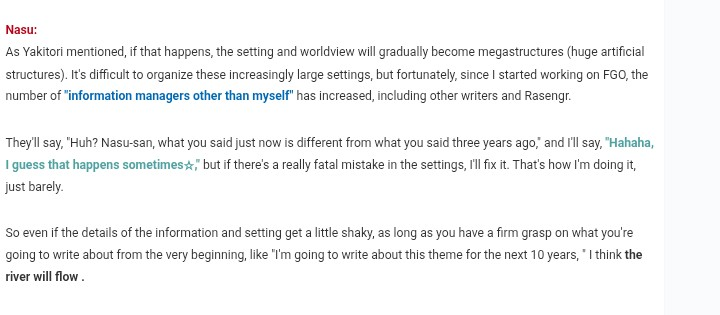
So clearly, the man himself doesn't keep track of everything particularly closely.
For all of these reasons, it would simply be an unnecessary complication to consider interview statements. The real approach is to confront the in-story capabilities of the characters and determine which one is superior, which is essentially how it has always been done anywhere.
-----
The list:
Important disclaimers and rules:
- I will rank multiple versions of the same character, for the sake of making a more detailed list.
- The rankings are based on how much a character can influence or dominate the world/reality if their abilities are used at full capacity.
- Characters within the same tier are not strictly ranked in order (Though I'll still try for the most part), as certain individuals may be more effective against others despite being weaker. So please do not take the order as absolute. However, I will mark specific characters with either a "-" or "+" to indicate whether they fall on the lower or upper end of the tier.
Important: Kishima Kouma's and Nanaya Shiki's explanation:
This section is very important for the rankings of Kouma and Nanaya. The reason is that they are, in all likelihood, Origin-Awakened characters, much like those we see in Kara no Kyoukai.
Origins are the fundamental "directions" that define a being's existence, shaping its natural talents and innermost urges. They are imperatives that compel reality to produce existences aligned with those directions, persisting regardless of reincarnation or transformation.
You can learn more about them in my KnK thread, but here are the most relevant quotes:
"The direction of everything that arose from fundamental cause. The α that enabled the existence of α, the absolute order that existed at the very core. For instance, something with the Origin of 'taboo,' regardless of being born as a human, animal, or plant, would always exist to go against the morals established by the collective. It was the idea that, independent of the process of reincarnation, humans acquired bodies and wisdom from the directional force at the point of origin, and acquired personalities that were only slightly different from their prior lives." - Garden of Sinners Pamphlet - [Other]: Origin
"Even when speaking scientifically, there are grounds for believing in reincarnation. Every particle that exists in the universe eventually changes forms, right? So long as you don't factor in concepts like our minds and souls, everything will eventually be reincarnated as something else.
An Origin is a means of retracing that orderless rule. There are some mages who allow themselves to be possessed by their past lives in order to use their abilities. Basically, it's an attempt to bring the abilities you possessed before being born into the present. An Origin is a similar concept, but it exists on an even higher plane than that. If we possessed lives before our current ones, then it'd only make sense for that life to also have one previous to it. Even if you weren't born as a human in your past life, and even if you weren't a living being in the life before that, there lies a thread of existence that ties it all together. For every one of us, there exists a beginning of our souls, a birthplace of our existences. However, the concept of living beings does not exist there.
All that exists is a genesis, a direction for causality to move in. Within the fount where all originates, an orientation toward something is born in a flash of lightning. That prerogative toward a certain something begins to flow, eventually taking a form suitable to it. Sometimes, it just so happens to be the form of a human being. Perhaps you could call it a driving force that emerged at the beginning of all things. It's an inescapable impulse to accomplish something born from within the chaos of the Fount of Origination. An absolute imperative for all that have been given form to fulfill their purpose. That impulse is what we mages refer to as an Origin." - Kara no Kyoukai Chapter 7
Merely being born close to an Origin is enough to develop psychic abilities. These unnatural powers are, paradoxically, as natural as breathing for the being in question, as they are simply the result of being closer to the concept defining their existence:
"However, there are people who are born a bit too close to their Origins. Just like people with psychic powers, they possess extraordinary abilities, and as a result tend to be outcasts of society. By the way, Shiki constantly seeks death because her Origin is Emptiness, and the reason why Azaka refuses to be bound by rules is because hers is Taboo. Shiki's being driven by that impulse because she's too close, but Azaka's pretty much a normal girl, right? An Origin is only a cause, meaning it isn't ordinarily something that rules over an individual. Unless you become aware of it for whatever reason, that is." - Kara no Kyoukai Chapter 7
The closer you become to your Origin, the more you are shaped by its concept. Once an Origin is awakened, the individual can attain great power at the cost of potentially being overridden by its urges, more specifically by an alternate personality embodying the Origin itself. In the process, the original personality constructed through the brain and life experiences may begin to erode.
To summarize, an Origin is an instinctual and foundational force defining a being's existence and natural inclinations. By being born close to it or having it awakened, it grants powers tied to its conceptual theme, which can be wielded with incredible fluidity and ease. This is exactly the case with Kouma.
For starters, Kouma was noted to be fundamentally different from birth. He preserved the clan's desired "purity", which they sought through interbreeding with pure demons, Ogres, yet ended up being so powerful that even his own clan eventually isolated him and grew afraid of him.
This already tells us that Kouma is closer to the "pure" existence of an ogre, a being associated with devastation and immense power, making it a much clearer existential direction than that of a human or most hybrids. Essentially, he began life in close proximity to his Origin.
It is even stated that he could resist his destructive impulses better than other adult hybrids, highlighting his far greater compatibility with those powers.


The Crimson Red Vermillion transformation is further stated to be an "ancestral return", where the individual appears to be possessed by another terrifying intelligence, marked by glowing red eyes:
A scarlet deeper than red.
A name for that has been passed down in the Nanaya oral tradition.
Crimson Red Vermillion.
A name that points to an existence that has awakened to the nonhuman blood of its ancestors.
It describes a person whose ego is subsumed by a transcendental self and loses all sanity.
It is said that the red Evil Eye is a sign of being possessed.
Like a mirage, something shimmers behind it.
Laughing around aimlessly as if insane.
It doesn't look like it's having any fun.
With the reed warbler's cry, its body becomes hazy. - Tsukihime - Far Side: Kohaku Route - 10/Locks of Hair.
The name Crimson Red Vermillion is unique to the families ruled over by the Tohno household. Elsewhere, it is known as Ancestral Return. - MB Act Cadenza PS2 manual - Crimson Red Vermillion [Term]
This "transcendental self" is most likely the Origin's personality, embodying the more fundamental nature of the being and bringing out its inner potential.
Kouma's CRV form would be significantly greater than most, as he was already born close to his Origin and later had it awakened.
Above all, when Kiri fought Kishima, he noted that their powers were similar yet fundamentally different. Kiri merely chased after Death. He trained and practiced it as a skill. Kouma, on the other hand, was born with Death as an innate property of his being, making him a killing machine through pure instinct rather than training.

Kiri then states that only a similarly "born broken" master of Death could fight him as an equal. This effortless "mastery" over Death, on such a deep and natural level, is exactly the kind of innate force an Origin embodies. Kouma received no formal training, yet he could already fight as a living instrument of Destruction.
The key difference is that the Nanaya style specializes in killing, while the Kishima lineage specializes in Destruction itself, reflected in Kouma's overwhelming physical power and Hellfire manipulation.
This strongly suggests that Kouma's Origin is Destruction. By having his Origin awakened, Kouma can wield this domain as second nature, guided by instinct rather than learned technique.
As for when his Origin awakened, the most likely point would be when he was shot in the head as a child. Near-death experiences are among the most reliable ways for an Origin to awaken, as seen with Ryougi's coma.
By becoming separated from the material body and glimpsing the abstractions within Nothingness, a being becomes more aware of its underlying cosmic principle and may return with sufficient understanding to awaken its Origin.
Now, for Nanaya Shiki.
Many are inclined to believe he is simply the young Shiki from before his memories were altered, but that is not the case. Shiki was still gentle and meek as a child, unlike Nanaya. Nanaya himself also reveals in the Ciel route that he is explicitly not Shiki's past, but rather his foundation:

Combined with the fact that he only begins to manifest after Shiki's near-death experience and the awakening of MEoDP, this strongly suggests that Nanaya embodies Shiki's deeper nature, his Origin. He is to Shiki what Void is to Ryougi: the personality of the Origin. MEoDP itself would then be the power Shiki gained after awakening that Origin through his near-death experience.
Even Arcueid notes that Shiki was already predisposed to developing MEoDP, and that the accident merely acted as the trigger:
"Just as I suspected. You had the latent ability, but that must have been the trigger... The Mystic Eyes of Death Perception, huh. Yes, with those, you could definitely kill even me." — Tsukihime, Arcueid Route
As discussed earlier, Kiri noted that Kishima did not wield Death the way a fighter or assassin would, but as an instinctual talent that even he could never hope to replicate. He then states that only a similarly "born broken" master of Death could fight him as an equal. Nanaya Shiki is one of the few characters repeatedly portrayed in those terms. Unlike Kiri, who pursued Death through training, Shiki possesses an innate connection to it through MEoDP and the Nanaya personality itself.
Nanaya himself confirms this in Melty Blood, stating he is Tohno's "guiding principle", an intrinsic part of his being that Tohno refuses to use:
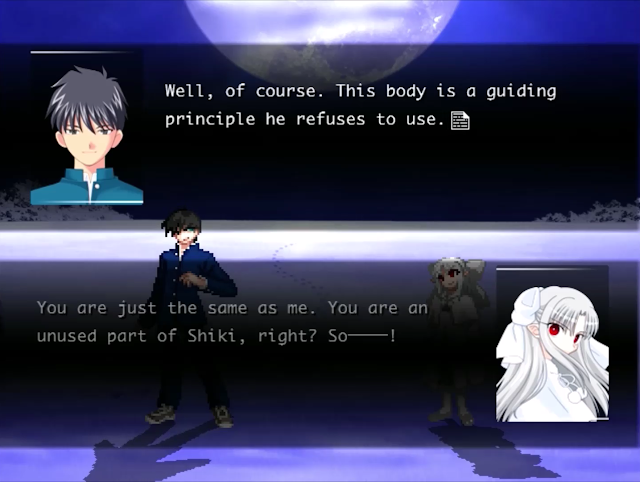
We also have multiple instances of Shiki's body moving on its own, achieving seemingly impossible feats through instinct alone:
"My body is moving by itself?"
No, that’s not it. All my arms are doing is seeking out the lines and points that I can see in the darkness with my glasses off... In other words, it’s not that I’m defending myself, but he’s defending himself from me."
— Tsukihime, Near Side: Arcueid’s route - 7/Eyes of Death Perception II
"My arms move as if they belonged to someone else... My eyes persistently, accurately look at just his 'lines'... My entire body burns. My brain feels like it is on fire."
— Tsukihime, Near Side: Ciel’s route - 9/Cast-Off Cicada Shell

Even against Akiha, he notes that the level of speed and reaction he displayed shouldn’t be physically possible. And yet, he instinctively moved out of her sight range in an instant, purely on reflex:

The story even outright describes him as a "transcendental killer" who "somehow" achieves these incredible levels of effectiveness whenever backed into a corner:
Though Shiki doesn’t remember it, he had received basic training before Makihisa’s attack.
This training was responsible for turning Shiki into a transcendent killer every time he was backed into a corner duringTsukihime… somehow. - Tsukihime Data Collection - Nanaya Shiki [Person]
Notably, Shiki only received basic training. Yet his feats vastly outclass Kiri's and are consistently portrayed as the result of instinct and alignment with his true nature. A defining trait of Shiki is that he becomes stronger the more willing he is to kill and the more fully he embraces that nature.
Even the Melty Blood manga hints at this:


Sion notes that Shiki's mind uniquely elevates his body when guiding it without hesitation, thanks to the killing skills embedded within his consciousness. She even explicitly notes that superhumans merely improve their "hardware", the physical body, whereas Shiki improves the "software", the mind, which then guides the body to perform at vastly superior levels.
So, to summarize:
- Nanaya is explicitly not Shiki's past, but his foundation, and he only begins to manifest after Shiki's near-death accident and the awakening of MEoDP.
- Shiki was already predisposed to developing MEoDP, meaning it was a natural ability that only required the proper trigger to emerge.
- Shiki's body repeatedly moves on its own when guided by instinct or pushed into a corner, achieving impossible feats by abandoning hesitation and embracing his true nature.
- Shiki's feats place him above the rest of the Nanaya clan despite receiving only basic formal training. His greatest accomplishments stem from instinct and natural talent, almost as though the training itself merely acted as a catalyst for something already present within him.
The evidence overwhelmingly suggests that Nanaya Shiki is Shiki's Origin personality and that MEoDP is the power gained through his Origin awakening.
Given the contrast Kiri drew between the Nanaya and the Kishima, if Kouma embodies Destruction, then Shiki's Origin is most likely Death. Looking at his abilities, that conclusion is hardly surprising.
-----
With that out of the way now, let's begin.
Honorable Mentions:
These are characters that cannot be properly ranked due to various unknown factors, but still deserves a mention.
-Touko's Sealed Box Demon:

Little is known about this creature, outside of Touko describing it as "endless", which, combined with its suitcase having "bottomless" darkness within it, seems to suggest that this entity is absurdly large or can grow to extreme lengths.
The problem is that we never really see it in action.
Some claim the demon can defeat Araya Souren as a means of downplaying him, but that is incorrect. Araya himself was never shown to be concerned about the demon, and he actually tried to convince Touko to use it, as if he didn't care either way. He said that it "might be able to defeat me", but it was clearly a taunt and not something he seriously feared, unlike later on with Self-Hypnosis Shiki.
Touko herself said she has no chance of winning within his apartment complex. She then says she refuses to use the demon because unleashing it may lead to the destruction of the complex and attract the Association. That is about it. There is no confirmation of it defeating Araya, only that it is dangerous and causes enough collateral damage to make the risk not worth it.
Besides, we already know it logically cannot defeat Araya by simply being "endless", because Mugen, the substrate from which his complex is derived, is infinite as well. But Mugen represents true infinity, not merely in terms of physical size, but as endless potential: a void of unrealized possibility that can contain the Taiji, which is the model describing how Light and Darkness interact with each other, and therefore every possible phenomenon that could ever arise from that interaction. And Mugen has actual explicit statements regarding this.
We already saw that Araya can cause the walls of his world to swallow opponents into Mugen. So if the demon is unleashed, it will simply phase through the interior and be trapped within the silent void beneath it, which is subjected to the Möbius Ring logic governing the entire realm.
Araya later even reveals that no physical impact can actually damage the walls of the complex, as it is a space infinitely chained together, making it formless and always leading into itself from a topological perspective. Any damage or deviation from its assigned state is therefore completely moot and immediately self-corrected.
So no, the demon cannot beat Araya by any metric. Araya stating that it "might" be able to defeat him is simply him trying to provoke Touko, as she cannot control it and unleashing it would lead to more harm than good for her.
If it is truly infinite in size, it would be at the top of Tier C. But the general uncertainty surrounding it makes it safer to place it as an honorable mention.
-Primate Murder:
I'll be frank here. This character is tied with ORT as the most baselessly overhyped creature in the verse.
It has done nothing of relevance, and its most praised ability is having the "absolute right" to kill the human race, meaning it has a special advantage against human fighters regardless of how powerful they are. But even that doesn't make it a top tier, as that ability isn't that great in the first place.
Sure, you can easily kill humans, but the top tiers of the verse are either not human or are Origin Awakened beings, who are exceptions to the system. That also doesn't account for it getting blitzed by such characters before it can even attack.
I am not even sure if it would work on someone like Zelretch, who defeated Type Moon despite the latter having complete control over the laws of Gaia.
Roa did say that Altrouge may have surpassed Type Moon "in a way" with Primate Murder at her side. But that isn't as amazing as it may seem, because Altrouge herself is already close to Type Moon in power. So PM would contribute little and only make her superior "in a way".
I suspect that "way" is merely it being capable of instantly killing human challengers. Crimson Moon lost to Zelretch due to underestimating him and not considering that humans could wield True Magic.
Had he possessed PM, it may have killed Zelretch before he could use the Second Magic to catch Crimson Moon off guard, forced him to reveal it earlier and lose the element of surprise, or simply given Zelretch one more threat to keep track of, making it harder for him to focus entirely on Crimson Moon.
So yeah. He belongs among the Dead Apostle Ancestor tier, with a sort of instant-kill privilege against non-outlier human fighters, but nothing beyond that. It is quite laughable that this dude is cited among the strongest in the verse when his track record is so scarce.
-Gun God:
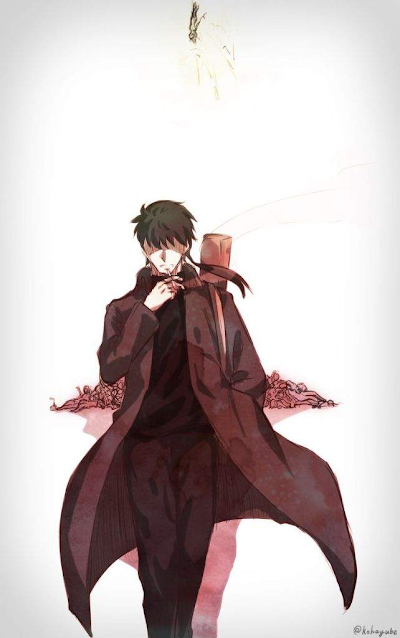
Gun God is one of the few unaltered humans remaining in Notes and wields the Black Barrel, a conceptual weapon engineered to impose mortality onto beings otherwise immune to death, namely the Types. Its bullets function like a lethal toxin, breaking down the target’s body on a cellular level, akin to accelerated cancer. The damage scales with the inherent lifespan of the "grain" composing their body, allowing Gun God the rare ability to kill a Type.
However, his personal combat ability isn't nearly as impressive. He fought Type Venus aboard a ship, which only survived due to being controlled by an obsolete AI. And this was only enough to get past the passive heat emanating from Venus' body.
So while the Black Barrel is a powerful weapon that can kill Tier B characters, its wielder doesn't really have much to suggest he can survive a direct confrontation with even lower tiers and actually land a shot.
With Types, it would ironically be easier, as their massive size and unfamiliarity with Earth's lifeforms can lead them to not even consider dodging a bullet the size of a grain of sand, unaware of its conceptual properties.
He is a niche kind of threat, but so overly specialized that he is better off as an honorable mention.
-Ado Edem:

Ether Liners are modified humans augmented by Grain, the crystallized life force of Gaia after its death. They populate the world of Angel Notes, a post-apocalyptic future shaped by humanity's last stand. Each Ether Liner wields a Knight Arm, a weapon powerful enough to engage the alien Types in battle.
Among them, Ado Edem stands out through Slash Emperor, a conceptual blade embodying humanity's tendency to consume the world's resources in order to survive and overcome adversity. Its activation accelerates Gaia's erosion while allowing the weapon to scale in size and power according to its target. The greater the enemy, the larger and more powerful Slash Emperor becomes. Against the enormous bodies of the Types, it can reach absurd proportions, granting Ado the ability to cleave entities that would ordinarily be beyond the reach of any human combatant.
At first glance, feats such as killing Types might suggest a high placement. However, Slash Emperor's effectiveness is heavily dependent on the nature of its target. Its greatest strength emerges specifically against massive beings, making it an extraordinarily specialized weapon rather than a universally superior one.
This specialization is reflected in Edem's own history. Prior to the arrival of the Types, he was not regarded as an exceptional figure among other Ether Liners despite already possessing his Knight Arm. Much of his legendary status stems from the unique compatibility between Slash Emperor and the enemies it was designed to oppose. Furthermore, the Types he defeated were among the lesser members of their kind, corresponding more closely to Tier C than the higher tiers of this ranking, and even those victories came only after fierce battles fought alongside his squad.
The majority of higher-tier characters, meanwhile, are human-sized opponents whose abilities revolve around conceptual manipulation rather than sheer scale. Against such enemies, Slash Emperor loses much of the advantage that makes it so terrifying. Since we do not know whether Edem possesses any additional abilities that would allow him to contend consistently with characters of that caliber, he is best treated as an honorable mention rather than receiving a formal placement.
-Type Pluto and the Six Sisters:
The Six Sisters were the leaders of the A-Rays, humanity's one hundred artificially created species designed to survive within Earth's ruined biosphere. Each Sister is stated to have wielded True Magic, and despite one of them being absent, they still managed to achieve a mutual kill against Type Pluto.
However, very little is known about the specifics of their abilities. We do not know which forms of True Magic they possessed, how those abilities were applied, or how Type Pluto compares to the other Ultimate Ones in terms of power. As a result, any attempt to place them within the ranking would be highly speculative.
For this reason, both Pluto and the Six Sisters are best treated as honorable mentions rather than receiving a formal placement.
-Aoko Aozaki (Fifth Magic):

This is Aoko specifically when using the Fifth Magic, not her normal adult self, who is ranked on the actual list (albeit barely).
True Magic has been portrayed as something capable of contesting even Ultimate Ones. The issue is that we do not actually know what the Fifth Magic fully entails.
Mahoyo was the first Type-Moon work, but the original novel remains unreleased, leaving only the 2012 visual novel adaptation. I do not consider that adaptation reliable for the purposes of this list, as it was produced long after the internal shift in Nasu's writing and worldview.
Within that version of the story, the Fifth Magic is shown defeating the sentient will of the cosmos itself in a contest of laws, and manipulating the placement and energy expenditure of timelines, effectively mimicking aspects of the Second Magic even while restricting it to a small scale use. Its broader theme is also heavily implied to involve entropy and the eventual heat death of the universe, accelerating cosmic decline if used recklessly.
If those portrayals are accepted, Aoko would easily belong in Tier A, as her influence extends beyond individual celestial bodies and their Ultimate Ones to the greater cosmos that contains them.
However, that material is not trustworthy from a continuity standpoint for the purposes of this ranking. For that reason, the only reasonable placement for Fifth Magic Aoko within the old lore is as an honorable mention.
-Riesbyfe Stridberg:

Riesbyfe is a knight of the Church and Sion's close friend. She wields True Apocrypha, also known as Gamaliel, the Spear Key, or Gun Shield, a Holy Scripture-class Conceptual Weapon shaped like a massive string instrument.
This weapon halts her aging and grants exceptional defensive power, allowing her to withstand attacks such as Zepia's Night on the Blood Lair without suffering damage.
Gamaliel can also manifest large glyph-based counterattacks that harm aggressors on contact and project an illusion of a ruined city beneath a false sunrise, though the exact nature and combat applications of this phenomenon remain unclear.
Most importantly, the shield prevents Tatari from completely absorbing Riesbyfe, allowing her to retain her autonomy in stories such as Actress Again. This also explains why Dust of Osiris is unable to command her.
Unfortunately, Riesbyfe's most concrete feats, like defeating Nrvnqsr Chaos and Vampire Sion, come from Actress Again. As that material falls outside the scope of this ranking, there is not enough reliable information to place her with confidence. For that reason, she is relegated to an honorable mention.
-True Chaos Nrvnqsr:

Yes, this is a thing. In his ending from Melty Blood Re-Act, Nrvnqsr Chaos ascends to "True Chaos." This state represents unrealized potential and the countless forms reality may take before any single possibility is selected. While superficially similar to Nothingness, the two concepts are fundamentally distinct.
Nothingness is the source of all possible things that could exist, existing prior to any system or definition. True Chaos, by contrast, consists of the potential manifestations of things that already do exist. Rather than creating possibilities from nothing, it represents the overlapping interpretations and unrealized forms of an already established reality. In simple terms, Nothingness exists outside all systems, whereas True Chaos exists within them.
However, the "True Chaos" Nrvnqsr refers to is not the cosmic principle itself, but the True Chaos of Tatari, the phenomenon underlying the Night of Wallachia. Under this interpretation, Nrvnqsr would become the embodiment of Tatari's total potential: the countless forms, rumors, fears, and manifestations the phenomenon could assume. Given that Tatari can materialize beings and events drawn from human belief, such a state would potentially place Nrvnqsr among Tier C characters.
The problem is that we simply do not know what this transformation actually entails. While it could represent a genuine ascension that grants authority over the entirety of Tatari's possibilities, it is equally plausible that Nrvnqsr was speaking metaphorically, referring to his dissolution back into Tatari's pool of potential manifestations rather than the acquisition of a fundamentally new level of power, as he was still a Tatari copy of the real Nrvnqsr after all.
Because the nature, capabilities, and limitations of this state are never explored in meaningful detail, any attempt to rank it would be highly speculative. For this reason, True Chaos Nrvnqsr is best treated as an honorable mention rather than receiving a formal placement.
F Tier: The Fodder Tier
These are the weakest characters in the verse. While still beyond normal people, they are nothing special overall.
F Tier: Azaka Kokuto

Azaka is Mikiya’s younger sister and a self-proclaimed rival to Shiki, though her actual capabilities fall far short. She lacks Magic Circuits and uses pseudo-magecraft resembling ESP, primarily through her signature "Spontaneous Combustion", an emotion-triggered spell that ignites targets internally via electrical disruption.
Despite her dramatic flair, trained magi can easily resist her spells. It is mentioned in the novel that magi can reject indirect spells like Touko's runes, forcing her to inscribe them directly through physical contact. Azaka’s combustion spell, which is theorized to be based on the Charged Corpus Theory, manipulates the body’s natural electrical activity, particularly during moments of psychological stress, to trigger spontaneous combustion. While it can be effective against untrained targets, it relies on indirectly interfering with a person’s internal state.
Against a trained magus, however, the spell would likely fail entirely. Since it operates through indirect bodily manipulation, any competent mage’s passive resistance would negate it, just like with Touko’s runes. So while flashy, the spell is virtually useless against anyone with even basic magical defenses.
In short, Azaka gets passively negged by any halfway decent magus, let alone the monsters that populate the rest of the setting.
She also has no notable combat feats, speed, or durability.
Physically average and magically unimpressive, her claims of surpassing Shiki are played for comedy. In truth, she openly admits she’s nowhere near Shiki’s level and trains obsessively every day just to cope.
Honestly, her greatest feat might unironically be believing that her brother would forget they are siblings and marry her after a brief time apart.
All style, no threat. Azaka sits firmly at the bottom of the verse.
E Tier: The Supernatural Tier
Characters in this tier are powerful within the ‘normal’ supernatural sphere, such as average mages, superhumans, or lesser vampires, but are systematically outclassed by those in Tier D, who can compete with higher level entities like True Ancestors or Dead Apostle Ancestors.
E- Tier: Cornelius Alba

An elite magus who aided Araya Souren in Kara no Kyoukai. Alba is a highly skilled practitioner of Magecraft, performing high-speed incantations that ignite intense flames within two seconds, with temperatures surpassing 1000 degrees Celsius. As the novel itself states, this heat is so intense that it can cause common solid objects to evaporate like butter, so efficiently that even the liquefaction process is skipped entirely.
Additionally, his flames can cover a significant area, engulfing both the ground and the air vertically like a geyser, making them much more lethal and difficult to evade in enclosed spaces. Even the oxygen itself appears to be consumed by the rampant sea of fire.
Thanks to his rapid incantations, Alba can also unleash these flames repeatedly. While most magi would require a pause to recover their strength or a lengthy chant to activate the spell at all, Alba requires less than two seconds to unleash his flames and can maintain a sustained rate of fire without pause, as he demonstrated against Touko's shadow familiar.
E- Tier: Kiri Nanaya

Known as the greatest assassin in history and called a "Demon God", Kiri relies on an unconventional, animalistic combat style that bypasses physical limits through unpredictable strikes. He uses the fullest extent of a human body's dexterity while manipulating three-dimensional space through deceptive maneuvers that allow him to kill enemies in seemingly absurd ways, often before they even realize what is happening.
His psychic ability, Pure Eyes, lets him sense the thoughts of his victims, revealing mental and emotional weaknesses to exploit.
Armed with a steel stick designed for silent, precise strikes to vital points, Kiri excels at stealth assassinations, with notable feats including killing Saiki, a hybrid demon capable of slaughtering dozens of demon hunters and altering temperature with his gaze; slaying multiple demon hybrids without being detected; and nearly killing Kishima by targeting his neck despite Kishima's normally impervious skin.
Now, you would think Alba would hard-counter him, given his ranged flame spam. However, Kiri has killed many demon hybrids, some of whom could alter temperatures like Alba through their gaze alone.
It ultimately comes down to his highly unpredictable fighting style, coupled with his ability to perceive certain emotional currents within his opponents. Because of that, I would favor him over Alba in an enclosed environment, where Kiri can make full use of his strengths. In contrast, I would give Alba the advantage in an open area with little to no cover. So while I ranked Kiri higher, the matchup could realistically go either way.
E Tier: Yumizuka Satsuki

A Dead Apostle with immense physical strength, capable of punching through asphalt and decapitating humans with ease. Her speed surpasses the visual perception of Shiki Tohno and ordinary humans, rendering firearms largely ineffective, as she cannot even be seen moving by their wielders.
Kiri himself confessed that, for all his speed, he cannot actually dodge bullets, relying instead on traps and his usual assassination techniques to take out armed men. This would make Yumizuka significantly faster.
A vampire's regeneration works by reversing time on wounds, quickly restoring the body and making conventional damage ineffective. A vampire's body is also moved and sustained primarily by blood rather than nerves, which reduces susceptibility to the pressure-point strikes used by assassins like Kiri. Combined with her physical capabilities, she should be able to make quick work of him.
You may cite his performance against Kishima, but the only reason he nearly killed him was through accumulated damage to his neck while repeatedly dodging his lethal strikes. Yumizuka's regeneration and vampire biology make that tactic completely ineffective, even if her actual physical strength is likely below Kishima's by direct showings. However, she definitely appears to be faster than him.
Yumizuka also wields a Reality Marble, Depletion Garden, which drains all magical energy from the surrounding area, devastating mages like Alba and elemental beings dependent on magic.
E Tier: Young Kouma Kishima

This is Kouma in his weakest iteration. While his Origin had already awakened by this point, he was barely clinging to life, both mentally and spiritually. With no will to live and no mastery over his power, his Origin expressed itself only through instinctive close-range destruction: raw, but unfocused. He possessed neither knowledge of his higher abilities nor the desire to develop them.
Kiri's final, deliberate attack reignited Kouma's will to live, triggering his Crimson Red Vermillion form, which grants Hellfire manipulation and deeper access to his Origin. Only then did Kouma begin training to fully realize his destructive nature and find meaning in his existence.
Despite being at such a low point, he still overwhelmed beings like Kiri Nanaya, possessing speed that surprised even the legendary assassin and the physical strength to crush a tree simply by driving his hand through it. His skin was also compared to steel, allowing him to walk through explosive traps completely unharmed.
However, his capabilities at this stage were almost entirely limited to his physical attributes. Kiri was still able to evade his attacks and eventually accumulate enough damage to Kouma's neck to nearly kill him.
Even so, his raw power alone is enough to place him in this tier.
D Tier: The Ancestor Tier

White Len is a fusion of a fragment of Len's suppressed self and a piece of Tatari, granting her the ability to combine dream manipulation with Tatari's power to manifest rumors. The result is vivid nightmares capable of materializing malevolent doppelgangers born from the hidden subconscious of others. She also commands ice and possesses complete control over Summer Snow, Len's dream realm, though its full capabilities remain unclear.
White Len's Last Arc involves trapping her opponent within a mirror and then shattering it, likely killing them instantly if the initial magical blast connects. She also draws power from nightmares taken from others, using them as fuel for Summer Snow.
In her Act Cadenza route, White Len uses this power to bring Arcueid Brunestud into her realm, severing her connection to nature and temporarily cutting her off from the planet itself. This leaves Arcueid with only her base physical abilities and vampiric traits. Under these conditions, White Len appears capable of surpassing Arcueid in strength, with Arcueid herself acknowledging that White Len is either her equal or slightly stronger while inside Summer Snow.
Despite this apparent victory, White Len ultimately flees, too afraid to confirm whether Arcueid was actually killed.
D- Tier: Ciel

As a skilled fighter of the Burial Agency, Ciel excels with a wide variety of weapons, especially her Black Keys: throwing swords capable of binding shadows and being enhanced through magical rites such as fire, petrification, desiccation, or the summoning of crows.
She is also formidable in close combat, possessing immense physical strength. Originally, Ciel was effectively immortal due to Gaia recognizing her as an anomaly tied to Roa's existence, continuously restoring her to full health regardless of fatal injuries. By the time of Melty Blood, however, this immortality had been lost, though she still retains powerful regenerative abilities. Critical injuries to vital areas can now kill her.
In the original visual novel, Ciel is stated to be capable of killing a vampire six times over with a single throw of her weapons. This already places her well above Tier E combatants, but it is in Melty Blood that she gains a more concrete benchmark.
There, Ciel is shown to be notably stronger than Sion, who can contend with Arcueid in close combat and even injure Warcueid, despite the latter possessing roughly 30% of Arcueid's base power. This places Ciel firmly within that general combat tier.
D- Tier: Akiha Tohno

In her base form, Akiha possesses notable physical strength and limited access to her Plunder ability, which allows her to absorb heat and energy from others.
Despite this restrained state, she is depicted as significantly stronger than Sion. While Sion ends up defeated and collapsing after her battle with Ciel, Akiha remains unharmed and is still capable of continuing the fight against her.
The Tsukihime manga further supports this portrayal. During her direct confrontation with Ciel, Akiha is shown holding a slight advantage, or at the very least fighting evenly.
D- Tier: SHIKI Tohno

As Roa's 18th reincarnation host, SHIKI Tohno possesses two unique abilities: Immortality and Fusion.
His immortality operates through internal reconfiguration rather than regeneration. By altering his body's structure, he can survive injuries that would normally be fatal, compensating for damaged organs and tissues through adaptive restructuring. However, he cannot regrow lost limbs or restore destroyed body parts. Instead, he preserves his life by maximizing the functionality of what remains. He can also absorb and assimilate the flesh of others, incorporating it into his own body to perform gruesome forms of biological replacement akin to organ transplants.
Most notably, SHIKI possesses highly advanced blood manipulation. He weaponizes his blood by shaping it into blades and projectiles or dispersing it across the battlefield as a lethal trap field. He can even trigger blood that has come into contact with an opponent to erupt into deadly spikes from within their body, making close-quarters combat exceptionally dangerous against him.
His second ability, Fusion, allows him to drain the life force of others, merging their vitality with his own to recover from injuries while simultaneously weakening his opponent.
He is often considered weak by the fanbase, but that is not really supported by his actual showings. In Akiha's route, SHIKI is able to keep pace with Ciel and ultimately exploits an opening to defeat her. Ciel herself notes that they have fought multiple times before and that SHIKI always manages to escape, leaving her uncertain whether she could dispatch him quickly even if given the opportunity.
He is clearly far above ordinary Dead Apostles and magi.

Sion is an alchemist from the Atlas Institute who can partition her thoughts, allowing her to calculate and predict optimal outcomes at exceptional speeds. Unlike magi, who use Magic Circuits to channel magical energy, alchemists rely on intellect and foresight to create powerful weapons and manipulate reality.
Her primary weapon, Etherlite, is a microscopic thread of Ether that can damage enemies, set up traps, extract information directly from a person's brain, and even take control of their nervous system. Through it, Sion can force others to follow her commands and, once they are no longer useful, destroy their brains outright. However, its effectiveness is notably reduced against beings such as True Ancestors, likely due to their deep connection to Gaia.
Sion also wields a Replica of the Black Barrel, a conceptual weapon originally designed to inflict damage proportional to the target's remaining lifespan. While the replica appears to lack this lethal function, she uses it to fire powerful projectiles and energy blasts that retain unknown properties, allowing it to remain effective even against True Ancestors.
Beyond alchemy, Sion possesses significant physical prowess as Wallachia's Dead Apostle. Arcueid herself notes Sion's ability to track her movements and predict her attacks, even questioning why Sion limits herself to alchemy rather than fully embracing her physical capabilities. Her Etherlite was also able to injure Warcueid, who possesses roughly 30% of Arcueid's power, and she survived Wallachia's Moon Drop without suffering fatal injuries.
After the events of the first Melty Blood, Sion appears to have grown considerably stronger, eventually defeating Ciel, who had previously outclassed her. This is consistent with Ciel's earlier observation that Sion was already stronger than the last time they had met prior to the events of Melty Blood, suggesting that she continues to improve over time.
D Tier: Aoko Aozaki

Aoko's unique magecraft works by firing pure magical energy bullets through the rotation of her Magic Circuits, much like the barrel of a gun. This grants her exceptional speed, precision, and destructive power despite her otherwise average conventional magecraft skills.
Her magecraft, known as Starmine and Starbow, relies on visualizing complex images that directly manipulate natural phenomena. Starmine channels fluid energy flows, while Starbow embodies unstable and fluctuating energy, often manifesting as explosive fireworks or rotating stars.
Aoko's Offensive High-Speed Incantation further enhances her casting speed, complementing a hybrid fighting style that combines martial arts with magecraft. She generates magical energy from her ribs and explosively expels it through her limbs, causing her arms and legs to function almost like rocket thrusters during combat.
The problem is that, for all the attention she receives, Aoko is essentially featless within the scope of this list.
Her main concrete showing is defeating Roa in Actress Again. However, I do not use that game due to it seemingly operating under the modern lore, at least in the case of Ryougi. As a result, Aoko loses the only clear benchmark available to her.
This leaves very little material for scaling. Fortunately, there exists an old Type-Moon chart stating that Arcueid would only have roughly a 70% chance of defeating Aoko, suggesting that she belongs somewhere within Tier D. It may not be much, but it is genuinely all that exists.
The same chart also notes that, if cornered, Aoko might resort to using something that would be "bad" for Arcueid. This is most likely a reference to the Fifth Magic, which has already been placed among the honorable mentions due to the lack of conclusive information regarding its exact domain and capabilities.
D Tier: Michael Roa Valdamjong (SHIKI's body)

In the Near Side routes, Roa fully takes control of SHIKI's body, asserting his dominance and unlocking its full vampiric potential.
His power at this stage is overwhelming, as demonstrated by his casual defeat of Ciel, whom he mockingly uses as both a chair and a dartboard. Ciel herself admits that she cannot defeat this version of Roa in a direct confrontation and would require a surprise attack to stand any real chance of victory.
Through countless reincarnations and an accumulated understanding of the process, Roa evolves SHIKI's Fusion ability into something that superficially resembles the Mystic Eyes of Death Perception. However, these are not true MEoDP.
Rather than perceiving the inherent "end" of all things, Roa perceives Life itself, specifically the vital energy or "fuel" that living beings rely upon to function. By targeting the "Lines" and "Points" of life, he can sever the flow of that energy, draining it to zero and effectively killing the target by shutting down both body and consciousness.
This ability is fundamentally more limited than true MEoDP. It functions only on living or sentient beings and has no effect on inanimate matter or metaphysical constructs, as it operates purely within the domain of biological vitality rather than universal metaphysical death.
D Tier: Night of Wallachia

Originally a powerful Dead Apostle and ancestor of Sion Eltnam Atlasia, Zepia was transformed by Altrouge Brunestud into the phenomenon known as Tatari, a formless curse that materializes rumors and fears. As an alchemist, he possessed extraordinary analytical abilities and was said to have calculated every possible future, ultimately foreseeing humanity's doom and attempting to prevent it.
Zepia's primary ability is the manipulation of malignant information, allowing him to weaponize data and rumors into tangible phenomena. His illusions possess a degree of reality, making them nearly indistinguishable from genuine attacks. He can also generate replicas of individuals based on rumors or subconscious impressions to aid him in combat, reproducing both their appearance and abilities. This extends even to exceptional figures such as Akiha Tohno and Nrvnqsr Chaos.
When summoned as a Tatari of White Len, Zepia proceeded to defeat Arcueid herself. Combined with Sion's recognition of him as one of the elite among Dead Apostles, this places him comfortably above the baseline Dead Apostle Ancestor level.
D Tier: Vampire Sion

Having fully embraced her vampiric nature, Sion now combines her intellectual alchemy with the physical power of a Dead Apostle. Her previous limitation, a relative lack of physical prowess, is gone. She now matches her prodigious analytical mind with superhuman speed, strength, and regeneration, making her a far more balanced and dangerous combatant.
Sion retains and further develops her previous techniques. Etherlite becomes even more versatile, capable not only of hacking bodies and inflicting electrical trauma, but also of materializing information-based constructs, including replicas of other characters and their abilities, much like Wallachia's rumor-born manifestations.
She also continues to wield the Replica Black Barrel. Combined with her high-speed thought partitioning, she can now operate her entire arsenal in sync with her enhanced physical capabilities.
This state first appears in Melty Blood, where she is depicted as nearly equal to Wallachia himself.

The Tatari replica of Kouma Kishima, created by White Len, exhibits an unusually strong sense of self, something Zepia himself notes as evidence of the immense power Kouma possesses in life. Despite being only a diminished manifestation, this version of Kouma was able to defeat Zepia, indicating that even a fragment of his original self remains a serious threat.
He retains his Hellfire manipulation, using it either for devastating close-range attacks or to engulf the surrounding environment in a raging inferno. Kouma can also briefly enter his Crimson Red Vermillion state, though without full access to the deeper conceptual abilities tied to his Origin of Destruction. This mirrors how the Tatari version of Nanaya lacks the Mystic Eyes of Death Perception; Tatari can reproduce form and function, but not the innermost metaphysical essence of the original.
Kouma is also among the few characters in this tier who would be largely unaffected by Arcueid's backup abilities. His combat prowess ultimately stems from his Origin, an intrinsic cosmic directive that exists prior to the material world, placing it beyond Gaia's direct influence. However, as a Tatari manifestation, his access to the full extent of his Origin Awakening remains restricted. While he retains instinctive and transcendent abilities, they are filtered through Tatari's fear-born nature, leaving him as only a shadow of what the real Kouma is capable of.

Ciel wields the Seventh Holy Scripture, a massive multi-form weapon that functions as a blade, rocket launcher, and firearm. Its primary attack fires a conceptual blast derived from a mythical beast's horn, capable of devouring souls and erasing them from the cycle of reincarnation. While the weapon normally requires an entire team of magi to operate, Ciel is able to wield it alone through extensive bodily reinforcement magecraft, granting her strength, precision, and speed far beyond her base form.
She also possesses a portion of Roa's inherited magecraft knowledge, including powerful lightning-based spells and the Secret Numerical Crests, giving her qualifications approaching those of a Grand-ranked magus within the Association. Roa himself remarked that her body came closer than any of his previous hosts to matching the potential of his original form, though official material clarifies that it never truly reached that level.
Despite her strength, Ciel struggled against Nrvnqsr Chaos in the Melty Blood manga, demonstrating that her access to Roa's abilities remains incomplete. She possesses only the fundamentals of his magecraft, primarily conventional lightning spells, and lacks his deeper mastery and advanced techniques. This limitation stems from the fact that Roa was killed by Arcueid before he could fully reconstruct himself within her body.
As a result, while Ciel was shown easily defeating opponents of the caliber of Tatari Arcueid, she remains well below the strongest Dead Apostle Ancestors and genuine reality-warpers, placing her firmly within Tier D.
D+ Tier: Tatari Nanaya Shiki

Tatari Nanaya is a Tatari manifestation of Shiki's soul and Origin personality, representing a hypothetical version of Shiki who remained with the Nanaya family and fully mastered their martial arts. However, as a construct created and influenced by White Len, this version is significantly diminished. It embodies Shiki's fear of becoming a killer and therefore lacks the Mystic Eyes of Death Perception, drastically reducing its lethality.
The Tatari struggles to accurately reproduce individuals whose fundamental nature conflicts with its own chaotic essence. Nanaya's true power stems from his Origin's transcendental killing ability and the extreme mental clarity required to wield it, both of which clash with Tatari's inherently disordered nature. Furthermore, this manifestation's personality was heavily influenced by Tatari, resulting in theatrical mannerisms and a tendency to turn precise assassinations into chaotic brawls. This disconnect further weakens the replica compared to the genuine Nanaya.
Despite these limitations, the Tatari retained a remarkable degree of Nanaya's martial prowess. Even with his skills distorted by Tatari's influence, he defeated numerous Tier D opponents, including the White Len Tatari version of Nrvnqsr Chaos. Most impressively, he was able to fight on even terms with Tatari Kouma despite carrying injuries from earlier battles. Although he acknowledged that these wounds had impaired his abilities, he still managed to keep pace with Kouma and even slash his throat. If anything, this serves to highlight the overwhelming potential of the real Nanaya Shiki, whose true capabilities would far exceed those of this incomplete manifestation.
Nanaya is also one of the few Tier D characters largely unaffected by Arcueid's backup abilities. When facing Wallachia's Tatari version of Nanaya in the MB manga, Arcueid was unable to land a single hit, with Nanaya casually dismissing her attacks as "half-assed" while keeping his hands in his pockets. She ultimately had to rely on her Archetype Earth personality to secure victory.
This resistance stems from the same source as Nanaya's combat ability: his Origin. Unlike ordinary techniques or enhancements, his skills are rooted in a fundamental cosmic directive that exists beneath matter and individuality, placing them beyond the authority of any single celestial body such as Gaia. Even so, this remains only a fragment of Nanaya's true potential. As a Tatari manifestation, his connection to his Origin is incomplete, allowing only a partial expression of the instinctive and transcendent abilities possessed by the original.
D+ Tier: Nrvnqsr Chaos

Nrvnqsr Chaos, one of the 27 Dead Apostle Ancestors, is an immensely powerful vampire acknowledged by Arcueid as a formidable rival even at her full strength. Unlike typical vampires, he has transcended his original form into a chaotic existence sustained by his unique and ever-active Reality Marble, the Lair of the Beast King. This internal world absorbs and integrates the lives of countless creatures, fueling his volatile and constantly shifting being.
His body is composed of a fluid, mud-like substance housing 666 beasts, manifestations of his essence ranging from mundane animals to colossal mythological creatures such as dragons and unicorns, each vastly surpassing their natural counterparts in size and ferocity.
Unlike a conventional organism, Nrvnqsr possesses no truly vital body. His existence is distributed throughout the 666 lives composing the Lair of the Beast King. Even if his apparent body is destroyed, he can regenerate from any surviving beast, emerge from one creature into another, or disperse himself among the entire swarm. As long as sufficient lives remain, destroying any individual manifestation accomplishes little.
This grants him an extraordinarily unpredictable fighting style. He can release his beasts as an overwhelming horde, flood entire areas with countless predators, or incorporate them directly into close combat, causing claws, jaws, horns, wings, and entire creatures to erupt from his body without warning. Because his true form is a fluid mass rather than a fixed organism, he can also dissolve into mud-like matter, flow through narrow spaces, evade attacks in unconventional ways, and reform from unexpected directions.
Most importantly, the beasts are not rigidly predetermined. Nrvnqsr himself admits that he does not always know what shape his lives will take. The creatures are influenced by circumstance, instinct, and necessity, causing the Reality Marble to continuously generate new and often unexpected expressions of life. As a result, fighting Nrvnqsr is less like fighting a single opponent and more like confronting an entire ecosystem condensed into one existence, constantly adapting and reshaping itself in response to the battle.
One of his signature abilities, Soil of Genesis, traps and crushes opponents by harnessing the combined power of a large portion of his beasts. Even Arcueid at 30% strength struggles to escape it, and overcoming the technique requires firepower capable of devastating entire continents. At his peak, Nrvnqsr can also manifest the 999th Beast, an ultimate form that condenses all of his lives into a single existence described as the "best beast."
Nrvnqsr is consistently portrayed as superior to both Roa and Wallachia. In the Melty Blood manga, he pushes Powered Ciel to her limits without even deploying his strongest beasts, instead only using Soil of Genesis to neutralize her Holy Scripture, a weapon specifically effective against vampires like himself. Even his weakened Tatari manifestation, created by White Len, was able to defeat Tatari Warcueid despite the latter being capable of defeating the real Arcueid with little difficulty.
Despite these feats, Nrvnqsr is often significantly downplayed for two main reasons.
First, some interpret Arcueid's victory over him while weakened as evidence that he is not particularly powerful. However, this ignores her unique connection to the planet, which allows her to temporarily increase her output far beyond her normal state. This boost was enough to briefly match Nrvnqsr's full power before exhaustion set in. Nrvnqsr himself also reveals that he only used a fraction of his power during that encounter, treating it as a test and withholding many of the more dangerous beasts he later unleashed against Nanaya. Arcueid herself later acknowledges that defeating Nrvnqsr would be extremely difficult even if she still had her full 30% power.
Second, Tohno Shiki's remark that Ciel moves "as fast as Arcueid tearing apart Nrvnqsr's beasts" has caused considerable confusion. This statement does not imply that Ciel possesses comparable raw speed or power. Rather, it highlights her exceptional skill, precision, and fluidity when compared to the beasts, which primarily rely on instinct rather than refined technique. While the beasts possess overwhelming physical power and speed, Ciel's finesse surpasses theirs. Interpreting it in that manner is more consistent with the rest of the story, which portrays even Roa, a character explicitly weaker than Nrvnqsr, as being capable of casually defeating Ciel.
D+ Tier: Len

This may come as a surprise, but Len has actually defeated Tatari Nanaya in Re-Act, securing her place within this tier. While this may initially seem unexpected, it aligns well with her unique nature and abilities. White Len, a fragment of Len herself, is already portrayed as relative to 30% Arcueid, highlighting the considerable latent power contained within her existence.
Len's original creator and master was an exceptionally skilled magus, capable of reversing the mental alterations inflicted upon Arcueid by Einnashe. Whereas Einnashe specialized in Memory Remodeling, Len's master excelled in manipulating the subconscious, burying memories deeply enough to override external influence. Since Len was created by this master, it is reasonable to infer that her dream manipulation stems from the same general specialization. This is particularly important because it demonstrates that this type of ability can affect even beings like Arcueid and other True Ancestors. Rather than merely targeting surface thoughts, Len's powers operate on deeper subconscious processes, which explains why they remain effective against entities that vastly surpass ordinary humans.
This helps explain how she can contend with opponents such as Tatari Nanaya. Her ability to interfere with deep mental processes gives her an advantage against physically oriented fighters, potentially causing them to lose control over their abilities, forget crucial information, or otherwise become unable to properly utilize their powers.
D+ Tier: 30% Arcueid

Operating at roughly 30% of her full power in order to suppress her overwhelming bloodlust, Arcueid possesses immense physical strength, rapid regeneration, and near-immunity to Magecraft. Through her deep connection to Gaia, she can draw upon an effectively limitless supply of energy, allowing her endurance and combat potential to continuously scale to match, and eventually surpass, opponents bound by Earth's physical laws.
Her Marble Phantasm allows her to manipulate and manifest natural phenomena within Gaia's framework, enabling feats such as creating vacuums, freezing the atmosphere, and generating various environmental hazards.
Despite her immense power, Arcueid must regulate her output carefully to avoid exhausting herself. Her gradual backup defenses are also primarily designed to counter direct physical threats and can be bypassed through conceptual attacks, non-physical abilities, highly specialized strategies, or even by killing her before her adaptive mechanisms have time to respond.
As a result, opponents who are significantly weaker on paper can still defeat her if they possess the right abilities or exploit the proper circumstances. Nevertheless, Arcueid's raw power, versatility, and capacity for adaptation place her firmly at the upper end of Tier D when fully engaged.
Tier D+: Tatari Arcueid/Warcueid
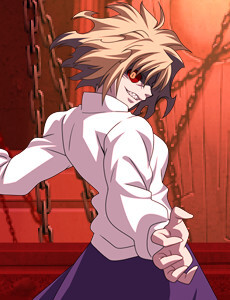
Tatari Arcueid embodies Arcueid's complete surrender to bloodlust, unlocking up to 100% of her power while lacking her normal restraint and judgment. Despite this, Wallachia was only able to draw out roughly 30% of her true strength due to the incompatibility between Arcueid's nature and Tatari's method of manifestation.
This form is a far more aggressive and chaotic version of Arcueid, releasing her True Ancestor backup defenses all at once rather than gradually. The resulting surge in power allows her to employ devastating abilities, such as using Marble Phantasm to create a mirror image of the Moon and hurl it at her opponents.
However, this reckless release of power comes at a cost. Tatari Arcueid sacrifices control, efficiency, and tactical judgment in exchange for raw destructive force. Her instability causes her to waste energy, overexert, or leave openings that more disciplined opponents can exploit. She has in fact been defeated by several characters, most notably the White Len manifestation of Nrvnqsr Chaos, whose extreme regeneration and chaotic fighting style are particularly effective against reckless opponents.
Unlike 30% Arcueid, who carefully regulates her power and gradually adapts to threats as Gaia's enforcer, Tatari Arcueid relies on overwhelming force from the outset, trading precision and adaptability for immediate destructive potential.
This difference is most clearly demonstrated in her battle against the real Arcueid, whom she defeats with ease while expressing surprise at how quickly the fight ended. This is likely because Tatari Arcueid does not wait for her backup abilities to develop over time, instead unleashing overwhelming power from the very beginning of the battle, killing her real counterpart before she had time to adapt.
D+ Tier: Vermillion Akiha

This is Akiha tapping into her demonic powers while still restraining her full potential in order to avoid succumbing to her Inversion Impulse. She is stated to possess an "ancient origin" that serves as the source of her immense latent power.
Her primary ability, Plunder, is a sight-based technique that absorbs heat and life force from targets within her range, with the potential to drain even conceptual traits. Rooted in the concept of "freezing," it rapidly strips away heat, producing intense burning sensations before eventually reducing the target to vapor. Plunder is further enhanced by Origami, which amplifies the red threads associated with the ability and allows them to manifest physically as restraints around targets within her field of vision. These threads can cover large areas and immobilize opponents, though they are less effective against spiritually fortified beings such as True Ancestors.
Combined with her enhanced physical abilities, Tohno family martial arts, and a rudimentary stealth technique reminiscent of the Nanaya style, albeit far inferior to the original, Akiha is capable of weakening, restraining, and ambushing opponents with remarkable efficiency.
In this state, she demonstrates overwhelming power on multiple occasions. In Tsukihime, she effortlessly defeats SHIKI, while Ciel later acknowledges in the manga that Akiha could have vaporized her with ease. In Melty Blood, she goes on to defeat notable opponents such as Tatari Nanaya Shiki and quickly eliminates a Tatari version of Powered Ciel in the manga, noting that it was nearly identical to the original in terms of abilities.
Pseudo C Tier: Touko Aozaki

Touko Aozaki specializes in rune magecraft, a discipline that produces specific effects by inscribing the corresponding rune into the air. One example is the rune Sowilō, which can ignite a target upon activation. However, Touko herself notes that such techniques are ineffective against even basic magi, as their Magic Circuits naturally reject indirect magical interference. As a result, she is often forced to apply runes through direct contact, a limitation that becomes increasingly problematic against many of the stronger characters in this ranking.
She also possesses an enhanced coat layered with powerful defensive runes capable of blocking interference directed at her Magic Circuits. While this provides a potent defense against many magical, physical, and elemental attacks, it proved completely ineffective against Araya Souren's spatial compression, demonstrating that its protection is not absolute.
By herself, Touko would belong much closer to Tier E. The real reason for her placement is her shadow familiar, a creature of magical darkness resembling a cat with a head shaped like a hieroglyph. Unlike a conventional familiar, it is not a living being, but a projection generated by the projection machine concealed within Touko's suitcase. This grants it a number of highly unusual properties, including extreme speed, the ability to glide through the air, instantly reverse direction as though ignoring inertia, and survive attacks that would ordinarily destroy a physical target. Cornelius Alba's thousand-degree flames, for example, failed to inflict any meaningful damage upon it.
The reason for this lies in the familiar's nature. The true familiar exists within the projection machine itself. What opponents encounter is merely a projection continuously inserted into reality. Because of this, the familiar is not fully constrained by conventional physical laws and can simply reform after being damaged, as the projection can be generated anew. In many respects, it behaves less like a creature and more like an image repeatedly imposed upon space.
Its most notable feat is its interaction with Araya Souren's bounded fields. These conceptual laws extended across multiple planes and dimensions, forcing reality itself to conform to Araya's internal order. While the familiar was initially affected, it eventually circumvented the bounded fields and caught Araya off guard. The most likely explanation is that the projection was continuously being reinserted from outside the bounded field's effective range, preventing the laws governing the interior from fully suppressing it.
Offensively, the familiar is equally dangerous. It can unfold its body into a massive mouth capable of swallowing targets into an interior space that appears as a flattened surface intertwined with its own form. This suggests that victims are gradually broken down into the same formless substance that composes the familiar itself. When it bit Araya's doll body, it tore away a portion of it cleanly, as though conventional resistance offered little protection.
Defeating the familiar is also extremely difficult. The most reliable method is to identify and destroy the projection machine hidden within Touko's suitcase. However, the familiar has demonstrated the ability to encase Touko entirely, rotating around her like a miniature tornado and shredding anything that attempts to approach. Matters are further complicated by Touko's puppets. Even if her current body is destroyed, another puppet may awaken elsewhere while the familiar continues operating as normal. The familiar has even demonstrated the ability to feign destruction in order to lure opponents into lowering their guard before attacking again.
However, the feat against Araya should not be overstated. The familiar never confronted Araya's true body. At the time, Araya was already operating through a temporary substitute vessel that had yet to be sublimated into a proper body, yet even that vessel did not fight Touko directly, instead controlling a remotely operated doll. While the doll could utilize Araya's techniques, there is little reason to believe it could express them at their full potency. As a result, the feat demonstrates that the familiar can bypass weakened manifestations of Araya's abilities, but not necessarily the genuine bounded fields generated by his true body. This is particularly relevant because Araya's true bounded fields are founded upon non-interference, stripping away the power and influence of anything that crosses their boundaries.
For these reasons, Touko is best placed at the very top of Tier D. Her projection familiar grants her a level of survivability, mobility, and offensive pressure that most characters in the tier simply have no answer to. Conventional attacks are largely ineffective against it, destroying Touko herself is often insufficient to end the fight, and many opponents would struggle to even identify the projection machine that serves as its true weakness. As a result, Touko can often defeat opponents who are individually stronger than herself through the sheer difficulty of permanently removing her familiar from the battlefield.
However, the familiar's power stems from a highly specialized interaction with reality rather than authority over reality itself. While this allows it to threaten, and under favorable circumstances even defeat, some lower-ranked Tier C characters (like Akiha or Demon Lords), it does not manipulate concepts or embody a fundamental principle in the way true Tier C powers do. For this reason, Touko stands at the absolute peak of Tier D, separated from Tier C more by the scope of her abilities than by their effectiveness.
Tier C: transcendental tier
This tier serves as a transition between conventional combatants and true reality warpers. Characters placed here possess conceptual abilities that transcend physical attributes, allowing them to reliably defeat opponents bound by the ordinary laws of nature regardless of raw strength, speed, or durability.
However, they are not yet genuine reality warpers. Their abilities are typically limited to a specific principle, concept, or aspect of reality rather than the broader system itself. While a true reality warper can manipulate large portions of a world's underlying laws, or even the entirety of them, characters in this tier can only influence a narrow part of that framework.
As a result, they stand decisively above purely physical fighters, yet remain clearly below those capable of rewriting reality on a fundamental level.
C- Tier: Demon Lords
Demon Lords are True Ancestors who have succumbed to their bloodlust, becoming monstrous beings no longer bound by restraint. The will they once used to suppress their instincts is now fully unleashed, granting them complete access to their Marble Phantasm.
Unlike conventional abilities that manipulate matter or energy, Marble Phantasm does not rely on rituals, spells, or external power sources. Instead, it is the direct manifestation of will imposing itself upon reality, allowing its user to interfere with natural phenomena by turning imagination into tangible results. This sets it apart from magecraft, as it draws directly from the user's connection to Gaia rather than from a magical energy system.
What makes Marble Phantasm exceptional is that it extends beyond the manipulation of physical matter. Its influence reaches abstract and intangible aspects of nature itself, allowing its user to alter probability and force highly improbable natural outcomes into reality. Rather than creating effects through conventional means, a Marble Phantasm user can simply make them occur. A flame may ignite where combustion should be impossible, gravity may weaken in a localized area, or a sudden storm may form without warning.
As long as something falls within Gaia's natural order, Marble Phantasm can make it real. Entire landscapes can be reshaped, natural disasters can be brought into existence, and the environment itself can be transformed according to the user's imagination. Even events with vanishingly small chances of occurring can be elevated to certainty, allowing the user to force favorable outcomes through probability manipulation alone.
However, Marble Phantasm remains bound to the domain of nature. It cannot directly affect things that exist outside Gaia's framework or concepts that have no place within the natural world. Rather than rewriting reality's underlying structure, it overlays reality with a "fantasy world" of possibilities born from the user's imagination, one that still operates within Gaia's domain.
Demon Lords occupy this tier because, despite their immense freedom within Gaia's system, they cannot fundamentally redefine it. They can manipulate, bend, and exploit the rules of reality, but they cannot decide which rules or concepts are valid in the first place.
Tier B characters, by contrast, possess authority over reality's underlying framework itself. Rather than deciding how concepts manifest, they decide which concepts are allowed to exist at all.
In simple terms:
• Demon Lords decide how concepts manifest within Gaia's system.
• Tier B characters decide which concepts are permitted to exist within the system itself, effectively defining the boundaries of reality.
C- Tier: Red Arcueid
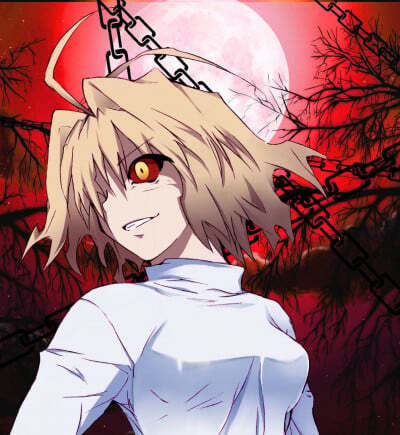
Red Arcueid is Arcueid unleashed, no longer restraining either her power or her bloodlust. In this state, she gains access to the full extent of her Marble Phantasm and the overwhelming abilities of a True Ancestor operating without self-imposed limits.
An important detail is that this form is stated to be equivalent to Crimson Moon while still being a completely different existence. This stems from Arcueid's original purpose. Before her corruption, she was an almost flawless being: an emotionless weapon devoid of personal desires or unnecessary functions. That purity made her the ideal vessel for Crimson Moon's reincarnation, allowing her to attain power comparable to his own.
However, everything changed after she drank Roa's blood. The impulse of bloodlust took root within her, contaminating the very qualities that had made her suitable as Crimson Moon's successor. In doing so, she became no different from the countless True Ancestors who had fallen before her.
As a result, Arcueid can no longer fulfill her original role as Crimson Moon's reincarnation. Instead, when she releases her full power, it manifests through the same vampiric impulses that define other fallen True Ancestors, making her effectively a Demon Lord rather than the perfect vessel she was meant to be.
For this reason, Red Arcueid is placed alongside other Demon Lords. She generally stands above them due to being Arcueid, whose base abilities and potential are exceptional even by True Ancestor standards. Nevertheless, she is still far below her original, uncorrupted self, who is ranked much higher in this list.
C- Tier: Michael Roa Valdamjong

In his original body, Roa was an exceptional magus. He founded the Burial Agency to combat the Ten Demon Lords, threats so dangerous that even the True Ancestors could not face them alone. Recognizing his unparalleled talent, they sought his aid directly. The Agency's success earned Roa a place within the True Ancestors' castle, cementing his reputation as one of the most respected and capable figures of his era.
Roa himself claimed to have reached a level of mastery where the limitations of the human body had become his greatest obstacle. Having effectively exhausted the potential available to a human magus, he concluded that further advancement required becoming a vampire and extending his lifespan.
Given his status as a magus who had essentially reached the pinnacle of human achievement, combined with his central role in the war against the Demon Lords, placing him within this tier is entirely justified.
The main complication is that his magecraft specialty is only explicitly identified in Actress Again, a source this list does not rely upon. There, Roa's craft is revealed to be Numerology, a discipline focused on understanding and manipulating the numerical foundations of reality. Such a field would neatly explain both his ability to contend with Demon Lords and his claim of having reached the peak of human magecraft. By influencing the equations underlying phenomena rather than the phenomena themselves, Roa could theoretically achieve a level of precision and versatility that surpasses the imagination-based nature of Marble Phantasm.
Even setting Actress Again aside, traces of this specialization appear elsewhere. In the Tsukihime manga, the weaker incarnation of Roa residing within SHIKI creates a lair based on an "Equation" that automatically repairs damage and continuously restores itself. While less explicit, it points toward the same underlying principle and further supports associating Roa with Numerology.
Beyond Numerology, Roa also researched ancient chaos manipulation, eventually passing fragments of that knowledge, known as the Soil of Genesis, to Nrvnqsr Chaos. Chaos, however, stood in direct opposition to Roa's preference for structured and symbolic systems, preventing him from ever fully mastering it. Even so, his ability to comprehend and transmit such an alien principle speaks to the extraordinary breadth of his knowledge and his standing as one of the greatest magi of his age.
C- Tier: Inverted Akiha

Akiha, when fully inverted into her Crimson Red Vermillion form, is explicitly stated to far surpass her normal self and may even exceed Berserker/Red Arcueid. While Red Arcueid's Marble Phantasm is immensely powerful, it is limited to manipulating natural phenomena and cannot directly affect beings that exist outside Gaia's domain. As such, there is insufficient evidence that it could simply negate Akiha's plundering ability.
Moreover, Akiha possesses a significant practical advantage in a direct confrontation. Her plunder requires little more than visual contact, allowing her to kill Arcueid before Marble Phantasm can be brought to bear. For this reason, the statement that she "likely" exceeds Red Arcueid reflects a favorable matchup rather than uncertainty regarding her power.
Akiha's Plunder allows her to absorb not only life force, but also traits and aspects of identity, provided the target lacks sufficient conceptual defenses. In her Inverted state, this ability expands dramatically. She can drain inorganic matter, such as walls, a feat that shocked Nanaya, and can even consume souls, as noted in one of the Bad Ends. At that point, her power functions less as simple absorption and more as a form of localized conceptual predation.
However, her abilities still depend on visual focus and clearly defined targets. Opponents such as Nanaya or Lio can evade her through unpredictability and Origin-enhanced speed that exceeds what Akiha's physically bound reactions can reliably track. She also struggles against reality-warping and highly abstract abilities that manipulate causality, space, or probability. Such phenomena cannot be perceived or grasped as fixed targets, preventing her from suppressing or draining them.
In theory, Akiha could overcome these opponents by plundering their abilities before they activate. In practice, this would require acting before the relevant effect is triggered, making success highly dependent on favorable circumstances or prior knowledge.
C- Tier: Type Saturn
Type Saturn is the Ultimate One of the planet Saturn. It is a 3,000-meter-long cross-shaped flying fortress composed of an unknown mineral. In Angel Notes, it serves as the leader of the Types, relaying orders and coordinating their actions. It attacks by raining down cross-shaped electromagnetic blasts of immense destructive power. These attacks appear to come in different varieties, as some are capable of boring deep into the planet's surface and triggering earthquakes that devastate entire landscapes.
Now, it may seem shocking to see a Type placed this low, but this is another point where I disagree with my former self. I once assumed that all Types occupied roughly the same tier, yet the available evidence does not support this conclusion. A Type is simply the strongest lifeform produced by a celestial body, the being that most perfectly embodies that planet's logic. That does not automatically mean all Types are equal, nor that one planet's ultimate lifeform must be comparable to another's.
From the information available, Type Saturn appears to be the weakest among the Ultimate Ones we currently know of. Ironically, it is also their leader. Perhaps that is the point. Saturn is traditionally associated with cycles, inevitability, and order. Rather than specializing in broader forms of reality manipulation, this Type appears focused on overwhelming firepower and environmental annihilation, allowing it to efficiently carry out the extermination of a planet's population while simultaneously coordinating the actions of the other Types and ensuring the invasion proceeds as intended.
Additionally, like all Types, Saturn lacks a concept of death due to its fundamentally alien nature. This means it cannot be targeted by many abilities that rely on altering or imposing concepts tied to terrestrial existence, and the destruction of its physical body does not necessarily signify the end of its existence. However, it is important to note that this trait is often exaggerated by fans and treated as a form of invincibility, which is not what the statement actually says. The material explicitly distinguishes between the destruction of a Type's body and the destruction of the Type itself. While Saturn may not truly die in the conventional sense, its physical form can still be damaged or destroyed by sufficiently powerful physical or supernatural attacks. As such, this trait should not be treated as an automatic victory against every opponent.
For all of its power, Saturn remains a fundamentally physical entity. There is no obvious conceptual component to its abilities beyond the unusual nature shared by all Types. The sheer scale of its electromagnetic bombardment would allow it to effortlessly destroy virtually every character in Tier D, while also overcoming some of the lower-end Tier C characters such as Akiha and the Demon Lords.
This is particularly relevant when considering the latter. While Marble Phantasm allows Demon Lords to manifest any natural phenomenon through probability manipulation, Saturn itself is not part of Earth's natural order and cannot be directly targeted by such effects. There is also considerable uncertainty regarding whether any natural phenomenon available through Marble Phantasm could realistically inflict fatal damage upon a structure of Saturn's scale and durability. Likewise, Akiha's Plunder is poorly suited to dealing with a target thousands of meters in size that remains high above the battlefield. Even assuming her ability could affect Saturn, there is little reason to believe she could consume something of that magnitude before being overwhelmed by its bombardment.
C Tier: Asagami Fujino

Asagami Fujino is an Origin-awakened individual whom Araya Souren deliberately selected as part of his plan to confront Ryougi Shiki. Araya's goal was not merely to challenge Shiki physically, but to force her to confront the nature of her own Origin, become more aware of it, and potentially be overtaken by the Void personality hidden within her.
His first attempt involved Lio Shirazumi, whose Origin he successfully awakened. However, Lio failed to produce the desired result. Realizing that a more direct approach was necessary, Araya turned his attention to individuals whose Origins diverged from the same fundamental source as Shiki's. Rather than awakening another unrelated principle, he sought variations of Nothingness itself.
Fujino was one such individual. Her abilities are explicitly described as psychic in nature, a phenomenon closely associated with proximity to one's Origin. Ironically, the years of artificial suppression imposed by her family only strengthened these powers rather than weakening them. Even experts in abnormal abilities note that Fujino far surpasses ordinary espers, possessing access to a channel of perception unavailable to normal humans.
Combined with her role in Araya's plan, this strongly suggests that her Origin had already awakened. By depriving her of normal sensation and pain, her family gradually pushed her existence into greater alignment with her Origin of Absence. The loss of touch, rather than suppressing her nature, brought her closer to it, likely serving as the catalyst for her awakening.
Unlike ordinary people, Fujino does not perceive the world as a collection of separate objects occupying distinct positions. Having never properly experienced physical sensation, concepts such as hardness, softness, and physical boundaries hold little meaning to her. Instead, she perceives space as a continuous field lacking the distinctions most people take for granted. Her psychic abilities allow her to externalize this perception, imposing it directly onto reality.
The result is a devastating form of spatial distortion manifested through her Mystic Eyes. The story repeatedly emphasizes that this is not telekinesis. Rather than applying force along a single vector, Fujino creates a distortion that twists its target in multiple directions simultaneously, collapsing normal spatial relationships. Victims are bent into impossible geometries as an invisible fulcrum forms around them, allowing her to rotate and distort their existence at will.
Because the attack directly affects space itself, conventional durability offers little protection. Anything that occupies space can be distorted regardless of its composition, density, or toughness. Likewise, the ability is not a projectile and cannot be conventionally dodged. As long as Fujino is aware of a target's position, the distortion manifests directly upon it.
Her Origin also grants perception and reactions that exceed what would normally be possible through physical senses alone. This gives her a notable advantage against many fighters whose powers still operate within conventional physical constraints, and even those with similarly sight-based abilities like Akiha.
Following her confrontation with Ryougi Shiki, Fujino's abilities evolved further through the development of clairvoyance. This largely eliminates her greatest weakness by allowing her to perceive targets beyond ordinary line of sight. Hidden enemies, distant opponents, and obstacles become far less effective against her, while her field of influence expands dramatically. At its peak, she demonstrates enough power to distort an entire bridge, showing that her abilities are not limited to individual targets but can extend across large sections of the environment itself.
The combination of instantaneous spatial distortion, disregard for conventional durability, enhanced perception, and clairvoyance places Fujino firmly among the baseline of this tier. Few opponents possess the means to resist an ability that directly attacks the space they occupy, and even fewer can reliably avoid it once they enter her awareness.
Even Type Saturn, despite its immense size and destructive power, possesses no obvious defense against Distortion. Scale offers little protection against an ability that attacks spatial relationships directly rather than physical structure. Fujino has already demonstrated the ability to twist an entire bridge, showing that massive targets remain vulnerable to her powers. Likewise, Saturn's conventional durability is largely irrelevant, as Distortion bypasses hardness and resilience altogether by targeting the space occupied by the object itself.
Nor does Saturn possess a clear advantage in speed. Fujino's attacks are not projectiles, but manifestations of her perception. The moment she becomes aware of a target's position, the distortion is applied directly. Given her clairvoyance and ability to affect large areas simultaneously, it is entirely plausible that she could distort Saturn before it has the opportunity to meaningfully leverage its overwhelming firepower. Even the electromagnetic attacks it launches remain physical phenomena occupying space, and therefore fall within the domain of Distortion.
If anyone wonders why Fujino is placed significantly below Ryougi Shiki despite the difficulty of their confrontation, it is important to remember the circumstances of that fight. At the time, Ryougi was still inexperienced with the Mystic Eyes of Death Perception and had not yet fully adapted to their use. Once she observed Fujino's distortions repeatedly, she was able to perceive their death despite their formless nature. Afterwards, despite having lost an arm and being on the verge of unconsciousness, she defeated Fujino with relative ease. This suggests that Fujino was only a serious threat because of Ryougi's unfamiliarity with her Eyes at the time. Once that limitation was overcome, the gap between them became considerably larger.
C Tier: Type Jupiter
Type Jupiter is the Ultimate One of Jupiter. It manifests as a gigantic humanoid entity several dozen kilometers tall, though its true nature is described as a mass of black photon gas emitted from an unknown object located at the center of its body. This core functions as a form of artificial sun, sustaining the immense structure surrounding it. When Slash Emperor eventually destroyed Jupiter, the core became unstable and released enough energy to scorch an entire continent.
Additionally, like all Types, Jupiter lacks a concept of death due to its fundamentally alien nature. This means it cannot be targeted by many abilities that rely on altering or imposing concepts tied to terrestrial existence, and the destruction of its physical body does not necessarily signify the end of its existence. However, it is important to note that this trait is often exaggerated by fans and treated as a form of invincibility, which is not what the statement actually says. The material explicitly distinguishes between the destruction of a Type's body and the destruction of the Type itself. While Jupiter may not truly die in the conventional sense, its physical form can still be damaged or destroyed by sufficiently powerful physical or supernatural attacks. As such, this trait should not be treated as an automatic victory against every opponent.
Unlike many of the higher-ranked entities in this tier, Jupiter does not appear to possess any obvious conceptual or reality-warping abilities. Its power instead stems from the sheer absurdity of its existence. Its body is not composed of conventional matter, but of a self-expanding mass of black photon gas that is stated to be capable of theoretically increasing in size without limit. Rather than functioning as a creature that merely possesses great power, Jupiter resembles a stellar phenomenon that has taken the shape of a living being.
This distinction places it above Type Saturn. While Saturn relies on overwhelming firepower and environmental destruction, Jupiter's very existence is a catastrophe. Its immense size, unusual composition, and artificial solar core make it vastly more difficult to meaningfully damage, while the energy contained within it eclipses anything Saturn has demonstrated. Even its death resulted in devastation on a continental scale.
However, Jupiter ultimately remains a physical existence. It does not manipulate concepts, alter perception, assimilate information, or embody a fundamental principle in the way characters such as Lio, Kouma, Venus, or Nanaya do. While it may possess greater raw power than many of them, its influence over reality itself is comparatively limited.
This interpretation is also fitting when viewed through the symbolism traditionally associated with Jupiter. The planet has long been linked to expansion, magnitude, and the continual pursuit of greater scale. Type Jupiter embodies these ideas almost literally. Its defining characteristic is not a unique conceptual authority, but the ability to continuously become larger, more expansive, and more overwhelming. Rather than influencing reality through subtle manipulation or abstract principles, it dominates through sheer presence. In many ways, Jupiter can be seen as the ultimate expression of growth itself: a stellar phenomenon whose answer to every obstacle is simply to become greater than it.
For this reason, Jupiter occupies the middle of Tier C. It stands as perhaps the greatest example of raw power and scale in the tier, yet remains below those whose abilities operate on deeper conceptual foundations.
C Tier: Lio Shirazumi
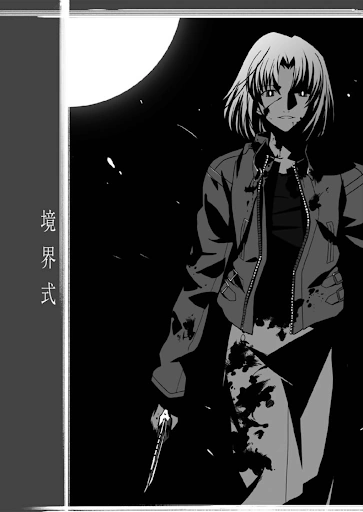
Lio is one of the most underrated characters in the setting, much like many of the major figures from Kara no Kyoukai. His power stems from his Origin of Consumption, the fundamental drive to devour, adapt, and survive that has shaped predatory lifeforms since the beginning of existence.
Even before fully surrendering himself to it, Lio was already capable of instinctively adopting predatory movements and hunting tactics far removed from those of a human being, constantly shifting between different expressions of biological adaptation. He also possessed a powerful regenerative factor, allowing him to recover from otherwise crippling injuries. This is because Consumption imposes survival and continuation as a fundamental imperative, continuously reshaping his body to overcome threats through adaptation, evolution, and regeneration.
Upon fully awakening his Origin, Lio undergoes a dramatic transformation. He develops retractable claws and is explicitly described as possessing speed and precision surpassing all creatures bound by flesh and bone, confirming that he has become the ultimate expression of a predator. Touko further notes that he can no longer be considered a single individual, but rather an entire pack of beasts condensed into one body, carrying the accumulated instincts and experiences of the countless lives shaped by Consumption throughout existence.
As explained in Kara no Kyoukai, an Origin is not merely a personal trait, but a causal current that has flowed since the beginning of existence. When an individual becomes fully aligned with it, their body transforms into an expression of that principle. In Lio's case, Consumption continuously molds him into the form best suited to hunt, survive, and overcome whatever stands before him. His adaptations are not limited to a single species or biological template. Rather, they represent the accumulated logic of predation itself, expressed through whatever form is most effective for a given situation.
This places him above characters such as the Demon Lords and Akiha. Consumption does not grant a fixed set of abilities, but continuously reshapes Lio into the most effective predator for the prey before him. Against them, his Origin would provide the precise speed, strength, instincts, and movement patterns necessary to outmatch them, allowing him to inflict lethal damage before a Demon Lord could fully bring Marble Phantasm to bear or to evade Akiha's Origami by simply moving beyond her ability to perceive and react. Even if this were not immediately sufficient, Consumption would continue adapting his body throughout the battle, gradually developing the means to overcome their abilities altogether.
The same principle applies to Asagami Fujino. While her Origin disrupts spatial order itself, she nevertheless remains a prey item, or at the very least an obstacle to Lio's survival, and therefore falls within the domain of Consumption. Just as Ryougi Shiki was able to evade Fujino's distortions through the abilities granted by her own Origin, Lio can likewise adopt the unnatural speed and movement necessary to avoid them. Should the confrontation continue, Consumption would not stop there. It would gradually adapt his body to resist the distortions directly or develop entirely new biological countermeasures capable of overcoming them. From the perspective of Consumption, Fujino's powers are simply another obstacle to be hunted, adapted to, and eventually consumed.
Even Type Saturn's immense scale and aerial nature do not place it outside the domain of Consumption. To Consumption, Saturn is merely another prey item, albeit one requiring a radically different expression of predation. Faced with such an opponent, Lio's Origin would continuously reshape him toward whatever form and abilities are necessary to engage and overcome it, whether through enhanced mobility, ranged adaptations, flight, or entirely new predatory traits.
The same logic extends to Type Jupiter. While Jupiter's scale far exceeds Saturn's and its body is composed of self-expanding black photon gas rather than conventional matter, it nevertheless remains something that exists, grows, and interacts with the world. From the perspective of Consumption, Jupiter is simply a far larger prey item requiring a correspondingly greater adaptation. Its immense size and unusual composition do not place it beyond the reach of the Origin, because Consumption is not concerned with the specific form an obstacle takes, only with overcoming it. Faced with Jupiter, Lio's body would continue evolving toward whatever expression of predation is necessary to hunt, survive, and ultimately consume such a target. Jupiter's answer to adversity is expansion, but Consumption's answer is adaptation. No matter how large or unusual an obstacle becomes, Consumption continuously seeks a more suitable means of overcoming it.
For this reason, defeating Lio requires more than simply possessing a powerful ability. One must either alter the fundamental rules upon which Consumption itself depends, or embody a broader and more fundamental Origin capable of overriding it. So long as a threat remains something that can be hunted, overcome, or adapted to, Consumption will continue searching for the means to devour it.
C Tier: Kouma Kishima

Kouma Kishima at his full potential is one of the most dangerous beings in the setting despite never being shown in that state directly. While we only see fragments of his power through his younger self and later manifestations such as Tatari, the available evidence is sufficient to place him within this tier.
Even before considering a fully awakened Origin, Kouma already scales above Inverted Akiha. Akiha's Crimson Red Vermillion state is derived from the awakening of an ancient ancestral self, with the transformation explicitly described as the emergence of a transcendental personality that overtakes the individual. The older and more powerful that ancestral origin, the greater the resulting manifestation. Kouma's lineage is both older and purer than Akiha's. As a child, he displayed compatibility with his Ogre blood that surpassed even adult members of his clan, allowing him to control impulses that others could not. If Akiha's transformation is enough to place her within this tier, Kouma's equivalent state must logically exceed it.
Kouma's primary ability is the manipulation of Hellfire, which he can release through explosions, spread across entire battlefields, or channel directly through his physical attacks. Combined with the Kishima martial arts, a style exclusive to his bloodline, he becomes a devastating close-quarters combatant. Significantly, the Kishimas are repeatedly associated with destruction rather than killing. Kiri Nanaya himself distinguishes the Kishima style from the Nanaya style, describing the former as specializing in destruction while the latter specializes in death.
Hellfire should not be viewed as ordinary supernatural flame. Kouma's Ogre nature is explicitly superior to Akiha's, and Akiha's Plunder is capable of affecting not only life force, but identity, souls, and potentially even concepts. Since Kouma's Crimson Red Vermillion state represents a purer and more powerful expression of the same ancestral principle, his Hellfire must likewise be understood as something operating on a deeper level than mere physical combustion. It is not simply heat or energy, but an extension of the destructive principle embodied by his Origin.
Under this interpretation, Kouma's Hellfire is not merely a supernatural flame. As an extension of Destruction itself, it seeks to erase the target's form completely, consuming every trace of its physical existence and overwhelming conventional defenses. Given that Kouma's ancestral nature exceeds Akiha's and manifests through the same Crimson Red Vermillion principle, there is strong reason to believe that Hellfire inherits similarly conceptual properties, allowing it to affect far more than simple matter. However, unlike Death, Destruction does not concern itself with the target's essence. This is the key difference between the two concepts. Destruction erases the shape of something, but not necessarily its underlying existence. Something destroyed may eventually be replaced, rebuilt, or reborn. Death, by contrast, represents finality. It concludes a thing's continuity altogether, returning it to Nothingness and denying any further progression.
The symbolism surrounding Kouma consistently reinforces this interpretation. His techniques in Melty Blood are heavily associated with Buddhist imagery and Yama, the ruler of the underworld. Likewise, the Ogre lineage from which he descends is traditionally connected to the wardens and punishers who serve under Yama's authority. In this context, Kouma's Crimson Red Vermillion state can be understood as the manifestation of such a being: a catastrophic embodiment of Destruction whose role is not to judge the dead, but to reduce them to ruin so that judgment may follow.
Further support for this interpretation comes from Nanaya Shiki's reflections on the Mystic Eyes of Death Perception. After considering whether the Eyes could kill abstract things such as emotions, senses, and even meaning itself, he wonders whether they could truly kill the Crimson Red Vermillion. While the question is never answered, its inclusion alongside such abstract targets suggests that Kouma's transformed state is viewed as something far more fundamental than a simple physical transformation.
Taken together, these factors place Kouma among the highest-ranked characters within this tier. His ancestral nature already exceeds Akiha's, while the conceptual scope implied by Destruction appears broader than the more specialized abilities possessed by characters such as Fujino. Even the overwhelming scale and firepower of Types such as Saturn and Jupiter do not compensate for the fundamentally physical nature of their abilities. Regardless of size, composition, or destructive output, they ultimately remain manifestations that can be destroyed. Jupiter may embody limitless expansion, but expansion itself still falls within the domain of Destruction. The only serious point of contention is Lio, whose Origin of Consumption is similarly broad and adaptive. Even there, however, Destruction can reasonably be argued to represent a more fundamental principle, placing Kouma slightly ahead.
C+ Tier: Nanaya Shiki

Nanaya Shiki represents Tohno Shiki at his peak. Throughout Tsukihime, Shiki's power fluctuates significantly depending on his mental state. The more he embraces his nature as a killer, the more he instinctively draws upon the abilities and instincts of the Nanaya bloodline. At his highest point, Nanaya becomes the dominant personality, allowing Shiki to fully express the potential hidden within his Origin. For this reason, I have chosen to rank them together rather than treating Nanaya as a separate character, as he represents Shiki's ultimate potential when his mind is clear and his intent to kill is absolute.
Nanaya's Origin is closely tied to Death, and this manifests immediately through his fighting style. The Nanaya martial arts are designed to extract every possible advantage from the human body, transforming ordinary movement into something closer to the behavior of a predatory beast. Their techniques rely upon deception, impossible angles, abrupt changes in momentum, and the exploitation of blind spots, creating a combat style that constantly disorients opponents and bypasses conventional defenses.
The effectiveness of this style is demonstrated repeatedly throughout the Nanaya lineage. Kiri Nanaya was capable of killing multiple demon hybrids without ever being detected. He assassinated Saiki, a hybrid powerful enough to slaughter dozens of demon hunters and possessing a perception-based ability similar to Akiha's, by dragging him beneath a table and dissecting him within an impossibly confined space. Despite being vastly inferior to young Kouma Kishima in raw physical power, Kiri was also able to nearly kill him by repeatedly targeting vulnerable points around his neck. The Nanaya style becomes even more dangerous in enclosed environments, where walls, ceilings, and three-dimensional space itself become extensions of the user's killing ability.
Nanaya takes these principles even further. As an expression of Death, his Origin continuously reshapes him into the ideal killer for the target before him, granting the speed, instincts, and physical capabilities necessary to exploit their weaknesses. He has demonstrated the ability to run across walls like a spider, perform movements resembling short-range teleportation, unleash techniques capable of delivering seventeen strikes in an instant, and execute Seven Nights, a technique in which he throws a knife and snaps the target's neck at the exact moment the blade makes contact.
Among his most impressive feats is the destruction of Nrvnqsr Chaos. Despite Tohno having been mauled to the brink of death moments earlier, Nanaya effortlessly cut through Nrvnqsr's strongest beasts, including creatures such as dragons and unicorns, before killing the 999th Beast itself. Significantly, Nanaya remarks that these stronger creatures simply possessed fewer points vulnerable to death, requiring him to become more serious. This strongly suggests that his effectiveness scales according to the difficulty of killing the target, with his Origin continuously adapting his body and instincts to better express Death.
A similar example appears during his battle against Inverted Akiha. Despite constantly losing life force throughout the fight, Nanaya moved faster than Akiha could visually perceive, repeatedly confusing her senses through erratic and unpredictable movement before ultimately killing her. Notably, all of these feats were achieved while Shiki was exhausted, dying, or operating far below his true potential.
However, Nanaya's true power lies in the Mystic Eyes of Death Perception.
These eyes grant access to a channel of perception that reveals the flaws inherent within all things in the form of lines and points. By tracing these lines, Nanaya does not merely damage the target. He removes the definitions that allow reality to recognize it. Limbs, abilities, traits, phenomena, and even the target itself can be severed from existence. Striking a Point of Death does not simply destroy the target's body, but eliminates the thing identified as "you" altogether. The collapse of the physical form is merely a side effect of this process.
Kara no Kyoukai further reinforces this interpretation by describing the Mystic Eyes as perceiving the "floor plan" of creation itself. Rather than observing physical matter, they reveal the definitions reality uses to recognize and categorize existence. Once those definitions are severed, reality can no longer coherently interpret the target, causing it to collapse into Nothingness as undefined potential.
Importantly, the Eyes are not concerned with life or death in the conventional sense. As Kara no Kyoukai explains, they only care whether something "moves." As long as a thing interacts with the world, it possesses a thread that can be cut. This principle allowed Ryougi Shiki to kill even an infinite void, and led SHIKI to speculate that the Eyes could potentially kill abstract concepts such as emotions or even the sixth sense itself. What the Eyes target is not the body, but the meaning behind existence.
The primary limitation of the Mystic Eyes is not their authority, but Nanaya's ability to perceive increasingly abstract forms of death. Throughout the series, his eyes undergo a clear process of evolution as his understanding deepens.
Initially, his perception was relatively limited. While he could kill living beings with ease, the effects resembled Kouma's Destruction more than true Death. Targets could have their forms destroyed, yet still reconstruct themselves afterward. The Eyes were killing the manifestation, but not necessarily the deeper meaning that allowed it to persist.
As Nanaya's perception evolved, this limitation gradually disappeared. He learned to kill not merely forms, but meanings. Nrvnqsr Chaos' beasts, which could previously regenerate after being destroyed, were no longer capable of returning once their deaths were properly perceived. Rather than simply dispersing them, the Eyes erased the definitions that allowed them to exist in the first place, returning them to Nothingness.
This progression continued throughout Tsukihime and Melty Blood. Nanaya eventually demonstrated the ability to kill Roa's soul without harming his own body, eliminate poison without damaging the afflicted person, and even target the Dead Apostle corruption within blood itself. In Melty Blood, he kills the fading form of Tatari, a being composed entirely of information and rumors rather than conventional matter. Sion herself notes that his eyes may be capable of killing concepts beyond human comprehension.
Perhaps the most extreme example appears in Kagetsu Tohya. There, Nanaya kills Maiko Yamase, the embodiment of True Chaos, a state lacking fixed identity or form unless given direction and interpretation. Arcueid describes her as a being merging Heaven and Earth, an intermediary state where abstract ideas acquire context before manifesting as reality. She further suggests that destroying such a being would require power capable of destroying the world itself. Yet Nanaya kills her instantly. The reason is simple: the Mystic Eyes do not care what a thing is meant to be. They target the existence identified as "you," regardless of whether that existence is physical, spiritual, informational, or conceptual.
In this sense, the Mystic Eyes represent the ultimate authority of Death. They embody the principle that all things possess an end and that all existence remains contingent upon Nothingness. No matter how complex, powerful, or abstract something becomes, if it can be identified as a thing, then it possesses a death that can potentially be perceived and returned to the source from which it emerged.
This authority extends beyond living beings and applies to phenomena, attacks, and even locations themselves. Nanaya has demonstrated the ability to sever ranged attacks, destroy Akiha's hair, and erase entire sections of the environment. One particularly notable example is the hallway he killed during his battle with Roa. The destruction of that space permanently damaged Roa despite his regenerative abilities. This was not because the debris itself was unusually powerful, but because the hallway had ceased to exist as a coherent thing. Its meaning had been erased. From reality's perspective, Roa was struck by something that no longer possessed a recognizable definition, leaving his regeneration with nothing to act upon. The resulting damage functioned almost as though he had been struck directly by the Mystic Eyes themselves.
His eyes are further enhanced by the Nanaya clan's Pure Eyes, a psychic ability that allows him to perceive things normally invisible to ordinary sight. This enables him to detect and interact with phenomena that would otherwise be impossible to target, such as Akiha's hair or other elusive supernatural manifestations. As a result, abilities that rely upon invisibility, intangibility, or unusual forms of perception offer little protection against him, and there is little reason to believe phenomena such as Asagami's distortions would be exempt from this principle.
However, despite the overwhelming authority of the Mystic Eyes, Nanaya ultimately lacks a reliable defense against Tier B and higher characters. While he may be capable of "killing" them if he can properly perceive them, their true advantage lies in their ability to alter the rules governing reality itself. Such changes are not always discrete objects or phenomena that can be easily seen and cut. It is possible that Nanaya could perceive the effects these powers leave upon the environment, much as Ryougi Shiki was able to perceive the death of Araya Souren's bounded field, but we do not know whether he could do so consistently or without severe consequences.
This limitation becomes increasingly important as the target grows more abstract. The more Nanaya attempts to comprehend the death of things beyond normal human perception, the greater the strain placed upon his mind. Unlike Ryougi Shiki, whose Origin grants her exceptional compatibility with the Eyes and resistance to alterations of existence, Nanaya possesses no such safeguard. Attempting to perceive realities that the human brain was never meant to understand risks overwhelming his mind entirely.
For this reason, Nanaya remains more appropriately placed within Tier C. While the authority embodied by Death may allow him to threaten even higher-tier entities, his ability to perceive and process those targets remains fundamentally human. Ryougi Shiki provides perhaps the strongest evidence for Nanaya's limitations. Despite possessing superior compatibility with the Mystic Eyes, she nearly destroyed her brain simply to perceive the death of Araya Souren's body, a being who, like the Ultimate Ones, lacked a conventional concept of death. Even then, she only destroyed his physical vessel rather than his overall existence. If such a feat demanded immense effort from Ryougi, it is unlikely that Nanaya could reliably replicate it against beings of similar or greater complexity.
C+ Tier: Type Venus
Type Venus is the Ultimate One of Venus, a parasitic lifeform that consumes foreign planets while gradually transforming them into extensions of itself. Its enormous tree-like wings continuously release billions of spores, which in Notes take the form of humanoid angels shaped by humanity's perception of Venus. While individually no more intelligent than wild animals, their numbers are so vast that the simultaneous release of the entire spore population would effectively mark the end of the planet's existing ecosystem.
Venus also emits a passive heat capable of interfering with and destroying the advanced aircraft deployed against it. Notably, the only vessel unaffected by this phenomenon was Gun God's transport, whose obsolete artificial intelligence appears to have made it immune to whatever interference Venus naturally produces.
However, the most interesting aspect of Type Venus emerges after its apparent death at the hands of the Black Barrel. Despite the destruction of its body, Venus continued to exist in a different form. By ingesting the concepts and thought processes of the planet's inhabitants, it gradually acquired the ability to manifest through an interface shaped by their collective imagination. While its corpse continued producing spores at regular intervals, Venus itself became capable of communicating through a form constructed from humanity's image of what it believed Venus to be.
This suggests that Venus operates on a level beyond simple biological invasion. Unlike Type Saturn and Type Jupiter, whose abilities are primarily physical, Venus demonstrates the ability to absorb, process, and incorporate conceptual information. It functions less as a single organism and more as an alien ecosystem that gradually converts foreign environments into extensions of itself while simultaneously learning from them.
Its spores appear to be expressions of this process. Rather than being fixed creations, they are shaped by the information Venus gathers from the world around it. As a result, there is reason to believe that Venus could gradually adapt its manifestations to better address increasingly difficult obstacles, incorporating the concepts and perceptions of the civilization it is consuming into its own expanding ecosystem.
While the exact limits of this ability remain unclear, it nevertheless places Venus well above purely physical Ultimate Ones such as Jupiter and Saturn. Its threat does not stem solely from destructive power, but from its ability to assimilate information, reshape ecosystems, and blur the boundary between biological and conceptual existence.
This interpretation is also fitting when viewed through the symbolism traditionally associated with Venus. The planet has long been connected to beauty, art, idealization, and perception. Type Venus appears to weaponize those very concepts. Rather than conquering through overwhelming force alone, it infiltrates the minds and cultures of those around it, absorbing their perceptions and then reflecting them back in an idealized form. Its angelic manifestations are not its true appearance, but rather a reconstruction built from humanity's collective imagination. In this sense, Venus functions almost like a parasitic embodiment of idealization itself, gradually turning the thoughts, beliefs, and perceptions of a civilization into extensions of its own existence.
Additionally, like all Types, Venus lacks a concept of death due to its fundamentally alien nature. This means it cannot be targeted by many abilities that rely on altering or imposing concepts tied to terrestrial existence, and the destruction of its physical body does not necessarily signify the end of its existence. However, it is important to note that this trait is often exaggerated by fans and treated as a form of invincibility, which is not what the statement actually says. The material explicitly distinguishes between the destruction of a Type's body and the destruction of the Type itself. While Venus may not truly die in the conventional sense, its physical form can still be damaged or destroyed by sufficiently powerful physical or supernatural attacks. As such, this trait should not be treated as an automatic victory against every opponent.
For these reasons, Venus occupies the upper end of this tier. It stands clearly above characters such as Akiha, the Demon Lords, Type Jupiter and Type Saturn, whose abilities ultimately remain focused on localized plundering, natural phenomena, or physical destruction. While characters such as Asagami, Lio, and Kouma embody broader conceptual principles through their Origins, their influence is still primarily expressed through an individual body. Venus, by contrast, functions on the scale of an entire ecosystem. It does not merely destroy, adapt to, or overcome obstacles, but gradually assimilates the information, perceptions, and conceptual framework of an entire world into itself. This gives it a scope of influence that extends far beyond direct combat and into the transformation of reality's inhabitants and environment alike.
The only character in this tier with a strong claim to superiority is Nanaya Shiki. Death is a more fundamental principle than Venus' conceptual assimilation, and the Mystic Eyes of Death Perception have repeatedly demonstrated the ability to affect increasingly abstract forms of existence. However, Venus remains an Ultimate One that lacks a conventional concept of death and exists simultaneously as organism, ecosystem, and conceptual manifestation. Whether Nanaya could reliably perceive and kill such a being before reaching the limits of his own perception is uncertain. For this reason, Venus is placed at the very top of Tier C, rivaled only by Nanaya himself.
Tier B: Reality-Warping Tier
Characters in this tier possess authority over the fundamental rules that govern reality itself. While Tier C characters wield powerful conceptual abilities, those abilities still operate within an existing framework. They can manipulate concepts, embody principles, or influence specific aspects of reality, but they do not determine the underlying rules by which those concepts function.
Tier B characters transcend that limitation. Rather than merely acting upon reality, they possess the ability to alter the conditions under which reality operates. They can decide which concepts are valid, redefine the relationships between them, or impose entirely new rules upon the world. As a result, they stand vastly above conventional conceptual users, as their authority extends not to individual concepts, but to the framework that gives those concepts meaning in the first place.
B- Tier: Altrouge Brunestud

Altrouge Brunestud possesses power rivaling that of Crimson Moon himself. In fact, this level of power is effectively a prerequisite for being recognized as True Ancestor royalty. Many readers underestimate her due to Roa's statement that she had not yet reached a high enough level to succeed Crimson Moon. However, this is often taken out of context. Roa immediately follows this by noting that Altrouge actually surpasses Crimson Moon in one respect due to having Primate Murder at her side, yet remains unsuitable as a successor because she is still too unstable. The issue, therefore, is not raw power, but stability. Altrouge possesses power comparable to Crimson Moon's and even exceeds him in certain areas, but lacks the stability necessary to properly serve as his reincarnation.
This interpretation is reinforced by her own condition. Altrouge requires a two-stage transformation to access her full power, with her base form being too weak to even utilize Marble Phantasm. This strongly suggests that she cannot maintain her true state indefinitely, forcing her to seal most of her power away and rely upon her bodyguards for protection during her weaker phases.
Despite these limitations, Altrouge unquestionably belongs within Tier B when her power is fully expressed. In addition to scaling relative to Crimson Moon and Archetype Earth, she possesses one of the most extraordinary feats in the setting: transforming the Dead Apostle Zepia Eltnam Oberon into Tatari.
Tatari is not a living being, nor even a conventional supernatural entity. It is a phenomenon that grants physical form to rumors, fears, anxieties, and collective human perception. More importantly, Tatari does not truly exist as an individual. It functions more like a typhoon or natural law. Whenever the necessary conditions are fulfilled, Tatari manifests. Destroying one manifestation accomplishes little, as another can arise whenever those conditions appear again. Conversely, when those conditions are absent, Tatari does not properly exist at all, remaining only as unrealized potential. This is demonstrated by the fact that even Shiki Tohno could not perceive lines of death on Tatari's true form, as there was no concrete existence for the Mystic Eyes to target.
This feat is categorically superior to ordinary applications of Marble Phantasm. While Marble Phantasm can manipulate and reinterpret natural phenomena through probability, it is fundamentally limited to the domain of nature itself. It cannot directly alter human beings, nor can it freely rewrite the existence of entities that stand outside the natural order.
Altrouge accomplished something far more profound. She directly altered a Dead Apostle, transforming Zepia from an individual into a phenomenon. Nor was this transformation temporary. The result was Tatari, a self-sustaining curse that reality itself continuously manifests whenever the appropriate conditions are met. Rather than merely manipulating existing phenomena, Altrouge effectively established a new rule governing how reality behaves.
This is the crucial distinction between the two. Marble Phantasm influences what nature does. Altrouge's feat determined what reality itself would do. She did not simply alter a phenomenon, but created one whose existence became woven into the world's own operation. That level of authority extends beyond conceptual manipulation and into the ability to define the conditions under which reality functions.
For this reason, Altrouge stands comfortably within Tier B. While her instability prevents her from maintaining her full power indefinitely, the authority she demonstrates when fully unleashed extends beyond concepts and into the fundamental rules that govern their manifestation.
B Tier: Crimson Moon/Type Moon

Type Moon is the Ultimate One of the Moon and the progenitor of the True Ancestors. Unfortunately, very little is known about his abilities directly. Beyond his defeat at the hands of Zelretch, the existence of an unknown Knight Arm called Real of the World, and a pair of Mystic Eyes whose effects remain undisclosed, most of his power must be inferred through those who inherited or reflect portions of his authority, namely Altrouge Brunestud and Archetype Earth.
We have already examined Altrouge's creation of Tatari. By transforming Zepia from an individual into a self-sustaining phenomenon, she demonstrated the ability to alter the very conditions under which reality operates. Rather than simply manipulating existing phenomena, she established a new one whose manifestation became tied to specific conditions and continuously reproduced by reality itself.
Archetype Earth demonstrates the opposite side of that same authority. During Melty Blood, she briefly surfaced through Arcueid and responded to Tatari by retrieving the Crimson Moon from one thousand years in the future. We know this was Archetype Earth rather than Arcueid herself because not only did she speak with Archetype Earth's distinctive mannerisms, but Sion explicitly remarked that the being before her was not the True Ancestor she and Shiki knew. The scene is therefore treated as a manifestation of Archetype Earth rather than ordinary Arcueid.
This immediately restored Zepia to his original state and caused Tatari to cease existing. The contract established by Altrouge dictated that Zepia would remain Tatari until he found an answer to the Sixth Law one thousand years later. By bringing that future into the present, Archetype Earth effectively altered the temporal conditions governing Tatari's existence, causing reality to recognize the contract as already fulfilled.
The implication is difficult to overstate. Not only was she able to affect a phenomenon that did not properly exist as a conventional entity, but she did so through direct manipulation of the conditions sustaining it. Wallachia himself remarked that such an act was on the level of Sorcery. This aligns perfectly with Crimson Moon's standing within the setting. He was powerful enough to engage Zelretch (who also wields Sorcery), and both Altrouge and Archetype Earth derive their authority from him. While the exact mechanics of his abilities remain unknown, the evidence consistently points toward an existence capable of defining, altering, and overriding the conditions through which reality expresses itself.
This interpretation is also fitting when viewed through the symbolism traditionally associated with the Moon. Unlike planets often linked to expansion, destruction, or conquest, the Moon has historically been associated with cycles, reflection, and the regulation of natural rhythms. Crimson Moon's authority mirrors this remarkably well. Rather than simply overwhelming reality through force, the powers derived from him consistently revolve around determining the conditions under which things manifest and persist. Tatari is governed by recurring conditions that cause it to reappear indefinitely, while Archetype Earth's intervention redefined the temporal framework sustaining its existence. In both cases, the focus is not on destruction, but on the authority to regulate the cycles through which reality expresses itself.
Additionally, like all Types, Crimson Moon lacks a concept of death. This means he cannot be affected by many abilities that rely on imposing or manipulating concepts associated with terrestrial existence, and the destruction of his physical body does not necessarily equate to the destruction of the Type itself. We know this because, even after Zelretch destroyed Crimson Moon's body, the True Ancestors continued to exist as potential vessels for his reincarnation.
However, this trait is often greatly exaggerated by fans and treated as a form of invincibility, which is not what the statement actually implies. The materials explicitly distinguish between destroying a Type's body and destroying the Type as an existence. A Type may not truly die in the conventional sense, but its physical manifestation can still be damaged or destroyed by sufficiently powerful physical or supernatural attacks, as Zelretch demonstrated against Crimson Moon himself.
As such, lacking a concept of death should not be interpreted as automatic immunity to defeat. It merely means that destroying the physical body does not necessarily eliminate the underlying existence behind it.
With that being said, Type Moon stands comfortably within Tier B. Unlike the Ultimate Ones of Angel Notes, whose powers are primarily expressed through overwhelming scale, physical superiority, or specialized conceptual abilities, Crimson Moon demonstrates authority over the rules governing reality itself. Through Altrouge we see the creation of self-sustaining phenomena. Through Archetype Earth we see the redefinition of their conditions and even their temporal foundations. Together, these feats place him far above most of the known Types and firmly within the realm of genuine reality-warping authority.
B Tier: Zelretch

Zelretch is the wielder of the Second Magic. True Magic is distinct from Magecraft in that Magecraft is ultimately the artificial reproduction of phenomena that already exist within nature, whereas True Magic, or Sorcery, performs things that fundamentally violate the rules of the world itself. Rather than recreating an existing phenomenon through a process of equivalent exchange, a True Magic achieves what should be impossible, bringing about a result directly "from nothing" and without obeying the normal laws governing reality.
This is why Sorcery is treated as such an extraordinary power within the setting and one of the few forces capable of contending with Ultimate Ones. By definition, a True Magic operates on a universal level that transcends the framework of the natural world. Magecraft remains bound to Gaia's system and can only manipulate what already exists within it. Sorcery, by contrast, produces effects that stand outside those limitations entirely. As a result, even the alien nature of a Type cannot simply ignore it, as True Magic does not rely upon the same rules that govern ordinary existence in the first place.
With that being said, Zelretch presents an unique problem within the older continuity, because we have almost no information regarding what the Second Magic actually does. This is surprising even to me, but there is simply no detailed explanation of it in the older material.
The first substantial description comes from Mahoyo's visual novel, itself an adaptation of a story originally written in 1996 and released long after Nasu had acknowledged that his modern views of the setting had diverged from many of his earlier ones. For that reason, Mahoyo cannot automatically be treated as reliable evidence for an older-continuity ranking.
What makes the situation even stranger is that modern Type-Moon has seemingly retconned that description. Zelretch is no longer portrayed as someone who freely manipulates timelines and worlds at will, instead requiring large quantities of jewels into which he transfers his form simply to travel between parallel worlds. This makes the modern version of the Second appear far more physical and limited than the one described in Mahoyo.
The only reason I am willing to consider Mahoyo's explanation at all is because these later retcons suggest that it may indeed preserve an older concept that was subsequently revised. There, the Second is described as complete control and management over parallel worlds, alternate timelines, historical records, and possibilities themselves. Under this interpretation, the Second is not merely dimensional travel, but authority over continuity and history.
What makes this particularly noteworthy is that Aoko herself, while restricting the scope of the Fifth Magic, performs actions that are explicitly treated as belonging to the domain of the Second. Touko repeatedly expresses confusion at the fact that the Fifth appears capable of producing effects normally associated with another Magic. These include redirecting attacks to different points in time, layering alternate versions of herself, entering and leaving the time axis, postponing death into the distant future, and importing years of experience from alternate histories into the present.
Taken together, this suggests that the original conception of the Second was not merely dimensional travel, but authority over temporal continuity, historical records, and alternate possibilities themselves. Interestingly, this interpretation aligns remarkably well with Archetype Earth's manipulation of Tatari, as both involve altering the conditions through which reality recognizes and expresses events. It would also provide a neat explanation for how Zelretch was ultimately able to defeat Crimson Moon.
To be clear, we still cannot be entirely certain that Mahoyo's 2012 description reflects the original conception of the Second, and I am only considering it because the newer lore retconned it into a more physical ability, following the recent trend of making many powers more concrete and action-oriented. If we discard that description entirely, Zelretch would still rank here regardless, as he factually defeated Crimson Moon. We simply would not know the exact nature of the abilities that allowed him to do so, much like Crimson Moon himself, ironically.
B Tier: Past Arcueid

Originally, Arcueid possessed none of the bloodlust issues that would later define her existence, allowing her to access her full power at all times unlike the other True Ancestors. In this state, she was noted to have effortlessly slain three Demon Lords and was explicitly stated to rival Crimson Moon in scale. This is consistent with the status of True Ancestor royalty, a title reserved for those sufficiently close to Crimson Moon in power to serve as potential vessels for his reincarnation.
The reason for this lies in Arcueid's original nature. At the time, she functioned less as an individual and more as a living weapon. She possessed no excess desires, emotions, or personal ambitions beyond the purpose for which she had been created. This purity of will made her the ideal vessel for receiving and expressing Crimson Moon's authority, in contrast to the far more unstable Altrouge.
All of this changed once Roa tricked her into drinking his blood. The act introduced the flaw of bloodlust into her existence, forcing Arcueid to permanently seal away roughly seventy percent of her power in order to suppress her vampiric impulses. In doing so, she also lost the degree of purity necessary to fully express Crimson Moon's will and authority.
As a result, the Arcueid seen throughout most of the series is only a fragment of what she once was. Even Red Arcueid, the state in which Arcueid unleashes one hundred percent of her power and ceases suppressing her bloodlust, is ultimately little more than a powerful Demon Lord. While vastly stronger than her ordinary self, she remains significantly below both Altrouge and the genuine Tier B characters. The original Arcueid, by contrast, possessed neither this flaw nor the limitations it imposed, and unquestionably belongs at this level.
B Tier: Archetype Earth

Archetype Earth is Arcueid's purest expression, deeper and more fundamental than her normal self. Initially, she mistook herself for Crimson Moon himself, but Tohno Shiki later made her realize in Kagetsu Tohya that she was a distinct existence. This shows that Archetype Earth fully embodies the purpose behind Arcueid's existence: the reincarnation vessel of Crimson Moon and the potential Type of Gaia, the Earth itself.
We saw a glimpse of her power when she brought the Crimson Moon from one thousand years in the future into the present, causing the conditions sustaining Tatari as a phenomenon to cease. This alone confirms that her power operates on the same scale as Crimson Moon and Altrouge.
The difficulty lies in determining exactly how powerful she is in relation to them. Ordinary Arcueid was already stated to rival Crimson Moon in scale, making it unlikely that Archetype Earth is simply equivalent to either of them. There is some additional material in Actress Again that could potentially be used to clarify this, but because it seemingly uses modern lore, it falls outside the scope of this ranking. In the end, all we are really left with is her title itself: Archetype Earth.
Why would she be called Archetype rather than Type? The name suggests a more fundamental role. A likely explanation is that, rather than merely being the strongest lifeform on a planet like a normal Type, she is the direct embodiment of the planet itself, granting her complete freedom in defining its reality and the rules existence obeys within it. This is broadly the interpretation suggested by Actress Again. There is also the fact that she effectively occupies two positions simultaneously: the equivalent of Type Earth and the reincarnation vessel of Crimson Moon, making her something akin to a dual Type.
Ultimately, however, we simply do not know enough to draw a definitive conclusion. For this reason, Archetype Earth is placed somewhat above the baseline for Tier B, representing an authority that is clearly greater than that of Crimson Moon and Altrouge, but whose exact limits remain uncertain.
B Tier: Prime Roa

Roa's already impressive power escalated dramatically after Arcueid drank his blood. Even before this event, Roa had reached the absolute limit of what a human body could achieve through Magecraft alone. Seeking to go further and ultimately attain True Magic, he concluded that he would first need to transcend the limitations of human lifespan. To accomplish this, he sought vampirization at the hands of Arcueid, the strongest of the True Ancestors.
A Dead Apostle's potential is determined largely by the strength of the vampire that creates them, and Roa deliberately chose the most powerful source available. Ordinarily, a newly created vampire begins as a mere Dead and requires centuries of growth before developing into a true Dead Apostle. Arcueid's power, however, was so overwhelming that Roa immediately became a genuine Dead Apostle and soon moved to unite the factions of the sealed Dead Apostle Ancestors under his influence.
His rise was so dramatic that Altrouge herself was dispatched to put him in his place. Instead, she suffered a crushing defeat. The side materials explicitly state that this outcome was "only natural", as Roa combined his extraordinary talent as a magus with the power inherited from Arcueid.
This alone places him firmly within Tier B. Defeating Altrouge is direct proof that the power Roa inherited from Arcueid was not a diminished fragment, but at minimum the full extent of the authority possessed by Arcueid herself. Since Arcueid's original state was explicitly described as rivaling Crimson Moon in scale, Roa's victory demonstrates that he successfully obtained power operating on that level. More importantly, Altrouge survived the encounter, as evidenced by her later role in the creation of Tatari. This strongly suggests that Roa did not even consider her a serious threat, as otherwise there would have been little reason to spare her.
Significantly, Altrouge never challenged him again, and the materials note that following this defeat, the entire group of the 27 Dead Apostle Ancestors effectively left Roa alone to pursue his research into immortality. This is particularly noteworthy because the Ancestors included Zelretch himself, the very man who had defeated Crimson Moon. Yet despite this, no serious effort was made to remove Roa. Instead, he was left largely undisturbed, with Roa himself confidently declaring that he had become the "most superior vampire." Given both his personality and accomplishments, there is little reason to interpret this as mere arrogance. In the end, it required the combined efforts of both the Church and Arcueid herself to bring him down.
Another important factor is the nature of vampirization itself. Becoming a vampire permanently stains the soul with the information of the parent vampire. In Type-Moon, the soul contains the informational blueprint of an existence, which is then expressed through the body and given context through the personality formed by experience and upbringing. We see evidence of this principle through Tatari's infection of Sion. Despite originally being an ordinary individual, she was gradually being transformed into the abstract phenomenon itself. This demonstrates that vampirization reshapes the victim toward the condition embodied by the source.
This becomes extremely significant in Arcueid's case. The deepest layer of Arcueid's existence is Archetype Earth. Arcueid herself is merely one possible expression of that underlying being. Her original, uncorrupted self was especially close to the purpose and authority that Archetype Earth represents. As a result, Roa's vampirization would not merely grant him the power of a particularly strong vampire, but access to the same fundamental authority rooted within Archetype Earth itself.
This provides a compelling explanation for how Roa was able to contend with and surpass entities operating on the level of Crimson Moon and Altrouge. He was not simply a powerful Dead Apostle. Rather, he combined the authority inherited from Archetype Earth with the precision, versatility, and accumulated knowledge of one of the greatest magi in history. In effect, he wielded a portion of Archetype Earth's power through the mindset and technical skill of a master magus.
For these reasons, Prime Roa stands comfortably within Tier B. His position is supported not only by direct scaling through his defeat of Altrouge, but also by the underlying mechanics of vampirization and the nature of the power he inherited from Arcueid herself.
B+ Tier: Type Mercury/ORT
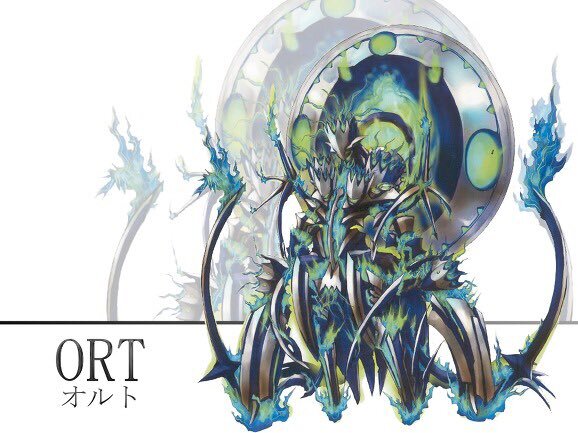
ORT, also known as Type Mercury, is the Ultimate One of Mercury before modern canon retconned it. While it never appears directly in the older continuity, its capabilities are described extensively throughout the supplementary materials. Its physical body is composed of a substance harder, more flexible, and more resistant to temperature than anything found on Earth. At this tier, however, such physical superiority is largely secondary.
ORT's true power lies in Crystal Valley, a planetary-scale Reality Marble that "paints" over a foreign world and rewrites its physical laws to conform to Mercury's order. This is an important distinction. Most Tier B characters possess the authority to alter the conditions under which reality operates or determine which concepts are valid within a given framework. ORT goes a step further. Rather than modifying the existing system, it substitutes that system with Mercury's own. As the materials themselves describe, ORT is an attack-type lifeform whose power is the greatest.
While other Ultimate Ones embody particular aspects of their planets, ORT's defining characteristic is intrusion. Crystal Valley does not negotiate with a foreign world, adapt to it, or coexist alongside it. It simply overwrites it. Rather than asserting authority within an existing reality, ORT replaces that reality with its own.
This also aligns surprisingly well with the symbolism traditionally associated with Mercury. While Mercury is often linked to travel, boundaries, and movement between different worlds or domains, ORT embodies those ideas in an alien and hostile form. Crystal Valley is, at its core, the intrusion of one world into another. Rather than adapting to a foreign environment, ORT carries Mercury's order with it and imposes it wherever it goes. In that sense, it represents the ultimate crossing of boundaries: not merely moving between worlds, but bringing an entirely different reality across with it.
Like all Ultimate Ones, ORT also lacks a concept of death. This means that conceptual abilities aimed at altering or ending its existence cannot properly judge it through earthly standards, as its nature exists outside the framework from which such concepts arise. As a result, ORT cannot truly be killed in the conventional sense. At best, its physical body can be destroyed, while its underlying existence remains unaffected. This is consistent with how other Types are described, where the destruction of the vessel does not necessarily signify the end of the being itself.
For this reason, ORT occupies the highest position within Tier B. Other characters can alter the rules of reality, define the conditions under which phenomena manifest, or establish entirely new laws. ORT's answer is far more direct: it replaces the system itself. In a tier defined by authority over reality, ORT possesses the broadest and most aggressive expression of that authority.
Tier A: The Top Tier
These are characters whose reality-warping or conceptual abilities operate on principles so fundamental that they remain applicable regardless of how reality is structured. Tier B characters can alter the rules under which a reality functions, but Tier A characters embody concepts that persist even when those rules themselves are changed. No matter how complex a system becomes, how many laws are rewritten, or how drastically reality is altered, these principles remain among the foundations that existence must still obey.
A Tier: Kirie Fujou

Kirie is an Origin-awakened being deployed by Araya Souren to confront Ryougi Shiki, force her to become more aware of her own Origin, and potentially be consumed by its impulses, allowing her void personality to take over. We know Kirie's Origin was awakened for this reason. Araya initially attempted the same approach with Lio by awakening his Origin, but quickly realized he was far too different from Ryougi to serve as a meaningful catalyst. He therefore shifted his attention toward individuals whose Origins diverged from the same fundamental principle.
As for when Kirie's Origin awakened, it was most likely after her incident and subsequent hospitalization. As her physical sight deteriorated, she began developing a different kind of perception that overlooked the area surrounding the hospital. This increasingly detached her from ordinary existence, bringing her closer and closer to the pure principle embodied by her Origin.
Kirie's Origin is a variation of Nothingness, as established previously. However, while Fujino's concerns the absence of physical sensation and the dissolution of spatial boundaries, Kirie's is significantly more fundamental. It embodies a broader disconnection from existence itself, an inability to meaningfully connect with the world that eventually develops into the desire to die or "fly" away from it altogether.
This is likely why her chapter is titled Thanatos. Thanatos is the universal death drive, the impulse toward dissolution, release, and nonexistence that exists alongside the desire to live. Most people experience only fragments of it, such as the strange urge that can arise when standing before an immense height and suddenly becoming aware of how insignificant one's existence is against the vastness of the world. For Kirie, however, this is not merely a passing feeling, but the pure expression of a much broader principle.
The Fujou family was already specialized in spiritual sight and communication with the dead. Kirie simply pushes those traits to their conceptual extreme through her Origin, much as Fujino elevates the Asakami family's telekinetic powers through Distortion, or Nanaya Shiki elevates the assassination arts of his clan into an expression of Death itself.
Araya later provided Kirie with a second body, one no longer burdened by her illness and therefore capable of being fully shaped by her Origin. The result was a ghost-like existence that could neither be touched nor touch others in return. Entirely defined by her Thanatos Origin, she embodied the dissolution of purpose itself, rendering conventional interaction with her invalid.
What makes Kirie truly dangerous, however, is her primary offensive ability. The idea of "flying" is not meant merely as physical motion, but as the desire to become free from reality and its burdens altogether. The novel repeatedly emphasizes that Kirie is not using hypnosis. Rather, she directly exposes the subconscious to the conscious mind, overwhelming rational thought and forcing the victim to act upon the impulse of release without resistance.
The subconscious serves as the filter through which the conscious mind interprets reality, while also containing the impulses and desires normally suppressed in order for rational thought to function. Dreams demonstrate this perfectly. While dreaming, a person can experience impossible events and accept them as reality without question. Kirie simply takes control of that filter. She makes the victim perceive the desire for release as their own reality and purpose.
This cannot be resisted through ordinary willpower, because Kirie does not impose a foreign command. Instead, she weaponizes an impulse that already exists within the victim, bringing it to the surface and elevating it above all others.
This is ultimately why Kirie belongs in Tier A. No matter how powerful a being may be, it still acts according to some underlying drive. Whether that drive is fulfillment, survival, reproduction, consumption, conquest, curiosity, or duty is irrelevant. Just as all things possess the potential not to be, presenting lines of Death to users of the Mystic Eyes of Death Perception, all wills possess the potential not to be as well. Kirie's Origin elevates that latent impulse above every other drive.
In this sense, Kirie functions almost as an inversion of other Origins. Origins normally guide an existence toward the fulfillment of a particular current. Kirie's redirects that movement toward its own dissolution. The question therefore is not how powerful or alien a target may be, but whether it possesses a purpose that compels it to act. Even the Ultimate Ones possess such imperatives as representatives of their planets. They still move according to a defining purpose and therefore remain participants in the current that Thanatos governs.
Furthermore, this is an Origin, a causal current that precedes existence itself. Origins do not care what something is, where it comes from, or under what laws it operates. They only care whether that existence can participate in their current. Given how fundamental Thanatos is, there are very few beings that can meaningfully place themselves outside its scope.
The only confirmed exceptions are Ryougi Shiki and Araya Souren. Ryougi's inner world is fundamentally undefined, reflecting the nature of her own Origin and granting her resistance to abilities such as Unified Language. Araya, meanwhile, possesses an internal world sealed from outside interference through perfect and unchanging coherence.
We even have direct evidence of Kirie's Origin overriding ordinary natural laws. Her victims persist as suspended apparitions visible even to complete strangers such as Shiki. Normally, ghosts linger only briefly and can generally be perceived only by those who possess some meaningful connection to them. Kirie's victims do not follow those rules. Her Origin has rendered them unbound by the ordinary laws governing spiritual existence. Even after death, they continue "flying" around her as companions, freed from the burdens of being.
Likewise, harming Kirie herself is extraordinarily difficult. She exists above the world, disconnected from it and from the systems governing ordinary interaction. Just as her victims cease obeying the usual laws of ghosts, Kirie herself ceases obeying conventional rules of contact and causality. She embodies the dissolution of meaning that invites the void into the mind.
In many ways, Kirie can be viewed as a mental counterpart to the Mystic Eyes of Death Perception. Rather than attacking meaning itself, she attacks the conscious self that assigns meaning to the world. For this reason, she ranks within Tier A. Her Origin encompasses all beings that act according to some purpose, no matter how insignificant that purpose may seem, making it one of the most universally applicable abilities in the setting.

Satsuki Kurogiri, also known as God's Word, is another Origin-awakened being used by Araya Souren to confront Ryougi Shiki, hoping that repeated exposure to individuals embodying aspects of her own Origin would make her more aware of her nature and eventually allow her Void personality to emerge. Like Fujino and Kirie, God's Word represents a divergence from the same fundamental Origin of Nothingness. Araya initially experimented with awakened beings in general, such as Lio, but quickly realized that entirely different principles would not produce the desired effect. He therefore began specifically searching for individuals whose Origins reflected aspects of Shiki herself.
We also know that Kurogiri's signature ability, Unified Language, is indeed a talent derived from a genetic mutation, one he managed to fully master in less than ten years despite it being something even the greatest magi would struggle to replicate.
As for when his Origin awakened, it was most likely during the incident in which he was abducted by fairies and subsequently killed them to escape. In retaliation, the fairies cursed him, fundamentally altering his existence and mentally freezing him at the age of ten. From that point onward, Kurogiri became incapable of recognizing his memories as truly belonging to him, preventing him from developing a stable sense of self. He could only comprehend reality through information and definitions. Even a slight change in something's appearance could cause him to forget it entirely, as it no longer matched the definition he had stored. In this sense, his existence gradually became inseparable from his eventual ability. Reality was no longer experienced subjectively, but organized through language, the only framework he could trust not to change or contradict itself.
If Fujino represents the emptiness of physical experience and Kirie the emptiness of purpose, God's Word embodies the emptiness of self. Reality is no longer interpreted through an individual perspective, but simply defined as it is.
This naturally leads into the Unified Language itself. According to the novel, this was the original language shared by humanity before the incident of the Tower of Babel. Unlike modern languages, it was not a means of communication between people. Rather, it was a language used to communicate directly with the world itself.
The text explicitly states that God's Word does not truly speak to people, objects, or locations. Instead, he speaks to the world's own recognition of those things. The world itself possesses records of everything that exists within it, preserving information through a system Touko compares to a lower-level analogue of the Akashic Records. Unified Language allows Kurogiri to directly access and interact with those records.
This is why Touko describes the ability as capable of placing "all of creation" under complete hypnosis. Kurogiri is not imposing his will upon individual targets. He is speaking to the world's own record of reality and convincing it that his declaration is true. As Touko herself explains, rejecting his words would be equivalent to denying one's own existence, because the same record he addresses is also what acknowledges a thing as existing in the first place.
For this reason, Unified Language is far more than ordinary reality warping. Kurogiri does not simply alter reality. He alters the world's description of reality. The distinction is subtle but crucial. Rather than forcing a phenomenon to change, he convinces the world that the phenomenon was always meant to function according to the definition he has spoken. His words become truth because reality itself accepts them as truth.
This makes Unified Language one of the clearest examples of a Tier A ability. It does not operate within a particular framework of laws, nor does it depend upon the structure of a specific reality. Instead, it acts upon the informational layer through which reality recognizes and records its own contents. As long as something exists and is acknowledged by the world, it necessarily falls within the domain of Unified Language. Unlike Tier B abilities, which alter the laws governing reality, Unified Language operates upon the layer that defines those laws and the things subject to them in the first place.
A particularly illustrative example occurs during Kurogiri's confrontation with Ryougi Shiki. He first commands Shiki to lose sight of him. As a result, he becomes invisible to her, with only his lines of death remaining visible. The world itself had accepted that the entity known as Ryougi Shiki was not supposed to perceive him. When he realizes that her Mystic Eyes of Death Perception are still partially bypassing this alteration, he escalates further by declaring that the location itself does not support sight. Reality obeys. The area plunges into darkness, not merely because light disappears, but because sight as a valid concept ceases to function within that space. Neither Shiki nor Kurogiri can see, demonstrating that the world itself has been altered rather than a single individual's perceptions.
Even so, Kurogiri ultimately retreats. He recognizes that if he approaches too closely, Shiki may still perceive him through other senses such as hearing, intuition, or general awareness. Once her brain reconstructs his presence through another channel of information, the Mystic Eyes could potentially be applied again. For this reason, he chooses not to press the confrontation further.
Even so, Unified Language remains one of the most universally applicable abilities in the setting. The Ultimate Ones themselves are not naturally exempt from it. Their identities, powers, and authorities all depend upon reality recognizing them as the beings they are. A Type is able to exercise the authority of its home world because the world's records acknowledge it as that existence. Unified Language operates precisely at that level. It addresses the layer of reality that defines what a thing is and how it is recognized.
This is why Kurogiri ranks within Tier A. Whether the target is human, spirit, vampire, magus, or Ultimate One is ultimately irrelevant. So long as reality acknowledges its existence, Unified Language can address the record through which that existence is defined. Kurogiri himself may not be a fighter and is repeatedly noted to lack the disposition necessary to kill another person, but that does little to diminish the significance of his ability. Through sensory deprivation, environmental alteration, incapacitation, or outright redefinition of how reality recognizes a target, God's Word possesses one of the broadest and most universally applicable powers in the entire setting.
A+ Tier: Ryougi Shiki

Ryougi Shiki is an Origin-awakened being created as the culmination of her family's research into producing a perfect vessel. She was designed to function as a "living program", an existence capable of housing countless software modules, each dedicated to mastering a particular skill, talent, or personality. This was intended to overcome the fundamental limitation of ordinary individuals, who can only fully specialize in a small number of pursuits during their lifetime.
This is possible because Shiki's Origin is Nothingness.
Nothingness is the primordial void from which all possibilities emerge and to which they eventually return. It is the state before definition, distinction, or identity. Every concept, every possibility, and every potential reality exists within it simultaneously. To define Nothingness is already to diminish it, because the moment something acquires a name or identity, it ceases to be undefined and therefore ceases to be Nothingness.
By expressing this Origin, Shiki's core remains fundamentally empty. Rather than being defined by a particular talent, personality, or specialization, she can continuously accommodate new possibilities. In this sense, she acts as a reflection of the primordial void itself, dividing into countless expressions before returning to an undefined state once more. Even her name reflects this nature. "Shiki" refers to a formula or program, while "Ryougi" refers to duality emerging from an original source. Ryougi Shiki is therefore an existence built around the endless expression and re-expression of possibility.
This directly informs her combat style. Shiki herself explicitly notes that her fighting ability does not originate from any fixed school or form. Instead, her mind continuously reconstructs the most appropriate way to use her body for each encounter. She takes the fundamental principle of martial arts, the idea that the mind can transform the body in order to overcome obstacles, and elevates it to an unnatural level.
Rather than relying upon a predetermined set of techniques, Shiki effectively rebuilds her approach from moment to moment. Her body expresses precisely the amount of speed, strength, technique, instinct, and behavior necessary for a given situation, drawing upon the infinite potential contained within Nothingness. She functions as a living program that processes possibilities, expresses the most suitable one, and then returns to an empty state so that it may express another. Unlike specialists, who narrow their potential through commitment to a particular path, Shiki remains fundamentally undefined.
This adaptability is reflected throughout her most impressive feats. During her confrontation with Asagami Fujino, she successfully evaded Distortion, an invisible, perception-based attack that directly twists space itself. Since the affected area is space rather than a projectile moving through it, conventional evasion should have been impossible. Yet the moment Shiki sensed the distortion gripping her body, she instinctively produced the precise movement necessary to escape. Her Origin supplied the possibility required to avoid what should have been an unavoidable outcome.
A similar example occurs during her battle with Lio Shirazumi after the complete awakening of Consumption. By that point, Lio had surpassed the limits of ordinary biological life and become a direct expression of his Origin. Despite being critically injured and on the verge of death herself, Shiki casually dismembered him so quickly that the novel notes he died before even understanding what had happened. No matter how powerful or evolved the target becomes, Nothingness continuously provides Shiki with the means necessary to overcome it.
Perhaps the clearest demonstration of this principle is her confrontation with Araya Souren. Throughout their encounter, Araya consistently held the advantage. Yet Shiki ultimately dismantled his defenses by first destroying his bounded fields and forcing him into a state of uncertainty. This disrupted his expression of Stillness, which depends upon absolute focus and decisiveness. She then executed a technique similar to Nanaya's Seven Nights, but arguably even more complex in execution.
Rather than throwing her knife in a direct line, she caused it to skim across the ground, severing two of Araya's barriers before abruptly changing trajectory and launching upward toward his forehead. Simultaneously, she closed the distance and drove her own blade into him following a shoulder charge powerful enough to break bones despite his superhuman durability. What makes this feat especially noteworthy is that the knife's trajectory appears to redefine itself mid-execution. Its movement ceases to follow the expectations established by its initial path, suggesting that Nothingness is not merely providing Shiki with extraordinary skill, but allowing her actions themselves to escape fixed definition. Like the void from which all possibilities emerge, her movements cannot be completely predicted or reduced to a single outcome.
Beyond her combat skill, Shiki also possesses extraordinary resilience. She can endure pain that would incapacitate most people, accelerate her recovery from severe injuries and selectively suppress nerve signals to continue fighting through wounds. During her battle with Araya, she continued fighting despite broken ribs and serious internal injuries, ultimately defeating an opponent who should have vastly exceeded her physical limits.
All of these abilities stem from the same source. Shiki's strength is not that she possesses a particular talent, but that she remains fundamentally unbound by any single one. As an embodiment of Nothingness, she is not defined by what she currently is, but by what she can potentially become.
Shiki's Origin does not express itself solely through combat. It defines her very essence.
When Kirie Fujou used her Thanatos suggestion against Shiki, she was only momentarily affected before discarding it entirely. This is unsurprising when viewed through the lens of Nothingness. Kirie's ability functions by elevating the impulse toward release above all other purposes and desires. Shiki, however, possesses no fixed direction at her core. Her inner world remains fundamentally undefined, preventing Thanatos from fully taking hold.
An even more impressive example occurs during her encounter with God's Word. When Kurogiri used Unified Language against her, he explicitly noted that its effects were weaker than expected because Shiki's connection to Akasha was comparable to that of his own words. This is an extraordinary statement. Unified Language derives its authority from speaking directly to the world's records, convincing reality itself to accept a new truth. Yet Kurogiri acknowledges that Shiki's existence possesses a similar degree of proximity to the Root. In other words, as an expression of Nothingness itself, her essence occupies a level comparable to the truths Unified Language imposes upon the world.
Taken together, these encounters demonstrate that Nothingness grants Shiki more than adaptability and combat prowess. It also provides a significant degree of resistance against attempts to alter her existence. Kirie's Origin struggles to impose a direction upon her because she lacks a fixed one. Kurogiri's words are less effective because her existence already stands unusually close to the source from which all possibilities emerge. In both cases, Shiki proves difficult to define, alter, or constrain within a single state of being.
This resistance is one of the primary reasons she ranks so much higher than her male counterpart Nanaya Shiki. Nanaya possesses the Mystic Eyes of Death Perception, but lacks any comparable protection against large-scale conceptual or reality-altering powers. Ryougi, by contrast, has directly demonstrated resistance to abilities operating on levels that equal or surpass many Tier B characters. Even if that resistance is not absolute, it dramatically increases her effectiveness against opponents who rely upon altering the conditions of reality itself.
This advantage becomes especially dangerous when combined with the adaptability granted by Nothingness. Shiki's Origin consistently provides the speed, instinct, and ability required to overcome whatever obstacle stands before her. During her confrontation with Kurogiri, she was even able to sever his arm before he could fully employ Unified Language. Later, despite Kurogiri removing sight from the area altogether, he still chose to retreat rather than continue the battle. He recognized that if he approached too closely, Shiki could potentially reconstruct his presence through other senses and once again apply the Mystic Eyes of Death Perception.
For this reason, Shiki's strength is not merely that she can kill almost anything. It is that she remains extraordinarily difficult to define, restrict, or force into a predetermined state. As an embodiment of Nothingness, she naturally resists powers that seek to impose certainty upon existence, allowing her to confront abilities that would overwhelm most other characters in the setting.
Finally, Shiki's most iconic ability is the Mystic Eyes of Death Perception. This power is a reflection of the fact that all things are contingent upon Nothingness and ultimately return to it. Through these eyes, she perceives the flaws and instabilities within all things in the form of lines and points, with even abstract concepts such as time and will explicitly mentioned as potential targets. By tracing these lines, Ryougi can immediately "kill" the target, bypassing conventional defenses, abilities, and states of being. The process is repeatedly described as something closer to existence erasure than physical destruction, with the collapse of the target's form being merely a consequence of its existence being brought to an end.
Importantly, this is not limited to living beings or physical objects, but is explicitly stated to work even on formless and intangible concepts. The Eyes can affect anything that possesses definition. As long as something can be identified as a particular thing, it exists as "something" rather than Nothing. The Mystic Eyes allow Shiki to return that defined existence to the undefined potential represented by her Origin.
Void Shiki further explains this process by stating that Ryougi perceives the "floor-plan" of reality itself. This can be understood as the underlying map describing how concepts, phenomena, and existences interact within the world's interconnected system. By tracing the lines that define a thing, Shiki causes reality to lose the ability to coherently recognize and interpret that existence. Its physical form, properties, and influence within the world vanish as a consequence.
This is why the Mystic Eyes bypass conventional defenses. Any defense, ability, or special property only functions because reality recognizes the target as existing in the first place. The Eyes do not attack those secondary attributes directly. Instead, they remove the concept of "you" from the system, causing every property that depends upon your existence to disappear alongside it. In this respect, the Mystic Eyes resemble Unified Language. However, while Unified Language forces reality to accept new truths, the Mystic Eyes simply remove truths altogether, treating them as though they had never existed.
Additionally, Ryougi's Mystic Eyes of Death Perception are effectively a hybrid ability that also incorporates aspects of Pure Eyes, a psychic perception possessed by members of the Nanaya clan. Pure Eyes allow the user to perceive things that are normally invisible to the human senses, and Ryougi is repeatedly shown and described as possessing this capability despite not belonging to the Nanaya lineage. This likely stems from her connection to Nothingness itself, allowing her perception to extend beyond ordinary physical sight. As a result, Ryougi can perceive ghosts, spiritual entities, invisible phenomena, and other targets that would normally escape human observation, enabling her to apply the Mystic Eyes to a far wider range of existences than would otherwise be possible.
Shiki has demonstrated the versatility of this ability repeatedly throughout the series. She killed Fujino's Distortions despite them being formless manipulations of space itself. She killed Kirie's second body despite it existing as a ghost-like entity beyond ordinary interaction. Most impressively, she killed Araya's bounded fields, conceptual laws without form or life that spanned planes and dimensions, something that shocked even Araya himself.
Above all, she destroyed Araya's Mugen, the foundation of his closed world. Mugen was an infinite void of Nothingness in which all possible phenomena arising from the Taiji, the model describing the emergence of existence through the interaction of Light and Darkness, were suspended under the influence of Stillness and endlessly looped into inaction through the logic of a Mobius Ring. Because Mugen was both undefined and protected by formless boundaries that rejected change, Araya believed Shiki would be trapped within it indefinitely.
Instead, she escaped.
Ryougi explained that while Mugen embodied true infinity, infinity itself is still a concept. It is something recognized by contrast with the finite and therefore possesses definition. Because it possesses definition, it possesses flaws. Because it possesses flaws, it can be killed. This feat is extraordinary, as it demonstrates Shiki perceiving and destroying an infinite conceptual structure far more abstract than the vast majority of entities within the setting.
She also possesses a second feat directly relevant to the Ultimate Ones. Ryougi successfully killed Araya Souren despite him lacking a concept of death. Unlike the Ultimate Ones, whose immunity stems from their alien nature, Araya lacked death because he was a completed being. His existence contained no unresolved processes, contradictions, or weaknesses through which external forces could normally interact with him. He was, in a sense, already complete and already stopped. Initially, Shiki could not even perceive his lines.
However, after enormous effort, she eventually managed to perceive and trace the lines of his physical body. Araya himself concluded that while his existence lacked death, his body still moved and acted within the world. The Mystic Eyes do not truly care about life or death in the conventional sense. They only care whether something possesses a thread, however small, that allows it to participate in reality.
This distinction is crucial. Shiki could not permanently erase Araya's overall existence, as he would eventually return through another generation. What she destroyed was the physical vessel through which that existence interacted with the world. The same logic applies to the Ultimate Ones. While the Eyes may not be capable of ending their total existence, the very statements describing their immunity also acknowledge that their physical forms can still be destroyed. As demonstrated against Araya, the Mystic Eyes are fully capable of targeting and eliminating that physical interface, preventing the supposedly immortal being from continuing to act within reality.
When combined with the limitless adaptability granted by Nothingness, her resistance to conceptual interference, and the overwhelming versatility of the Mystic Eyes of Death Perception, it becomes clear why Ryougi occupies the highest position within Tier A. She not only killed Kirie directly, but also forced God's Word to retreat despite Unified Language being one of the most universally applicable powers in the setting. Few characters possess abilities as broad as hers. Fewer still possess the means to meaningfully oppose them.
Perhaps the most impressive aspect of all is that everything described above represents only a substitute for Shiki's true potential.
Shiki herself admits that she has never genuinely employed the combat principles of the Ryougi family. Rather than expressing her abilities directly, she relies on techniques, movements, and combat methods she has observed elsewhere and subsequently reproduced. In other words, she still processes the infinite potential of Nothingness through pre-existing templates and familiar forms rather than expressing it in its purest state.
The same is true of the Mystic Eyes of Death Perception. Despite being her most iconic ability, they are not the true manifestation of her Origin, but merely a consequence of her near-death experience. The Eyes are an external ability acquired through contact with death, not the fundamental power of Nothingness itself.
This distinction is important. The version of Shiki that fights with a knife, adapts through combat, and employs the Mystic Eyes is already one of the most formidable beings in the setting. Yet even this remains a limited expression of what she truly is. Her actions are still filtered through learned techniques, familiar concepts, and human methods of understanding the world.
Araya Souren himself explicitly notes that Shiki's true self exists on an entirely different level. For this reason, the Shiki ranked here is not the ultimate expression of Nothingness, but merely the strongest practical manifestation of it that regularly interacts with the world. Her true nature belongs in an entirely different category, one that warrants placement in the next tier altogether.
S Tier: The God Tier
This is the highest tier, reserved for characters who embody the two most fundamental principles in existence: Nothingness and Stillness.
Nothingness is the primordial source from which all possibilities emerge. It is the undefined potential that precedes all concepts, identities, distinctions, and realities. Every thing that could be exists within it before acquiring form, context, and meaning, and ultimately returns to it when those definitions are lost.
Stillness is the complementary principle that allows those possibilities to become actual things. It is the force of completion and determination that fixes one possibility against all contradictory possibilities, granting it a stable identity and allowing it to exist as a distinct phenomenon rather than remaining undifferentiated potential.
These are not merely powerful concepts, laws, or authorities like those seen in Tier A and Tier B. They are the fundamental preconditions that make existence itself possible. Nothingness provides the possibility for something to exist. Stillness provides the certainty that allows that something to exist as itself.
Every being, every location, every phenomenon, every concept, and every power ultimately derives from the interaction of these two principles. As a result, characters embodying them do not merely operate within reality's framework, but stand at the foundation upon which that framework is built. There is effectively no entity in the setting capable of challenging them on equal terms, as even the powers of other top-tier beings ultimately depend upon the principles they represent.
S- Tier: Araya Souren

Araya Souren is genuinely overpowered, but the novel only recently receiving a proper translation, the complexity of his powers, and the far more popular anime adaptation omitting much of the underlying context have caused him to fly under the radar of almost everyone.
Araya is an Origin-awakened being whose Origin is Stillness. Stillness is described as "that which divides the inside from the outside" and as something Araya achieved after "completing himself", allowing him to "construct complete worlds from his own body".
Completion refers to the removal of contradiction. Normally, living beings and objects act, desire, and participate in processes because they possess something unresolved within them: an urge, a wish, a biological need, a structural flaw, a contradiction. When those things are removed, there is no longer any reason to move or act, as everything that compelled that movement has already been resolved.
This is what Araya achieves. By sealing away excess desire, instability, uncertainty, and unnecessary motion, he attains a state of absolute internal consistency. There is no longer an unstable point through which conflict, doubt, suffering, or even death can be introduced into his being. He becomes a self-contained existence that no longer depends upon interaction with anything outside himself. A serene state where existence unfolds exactly as intended and nothing external is permitted to interfere, hence the description of Stillness as "that which divides the inside from the outside."
From the perspective of an outsider, this may resemble stasis or even death. In reality, however, it is simply separation. Araya remains internally active, but becomes extraordinarily selective regarding what is allowed to interact with him at all.
This power is expressed through boundaries. A boundary is not merely a wall, but the limit that defines all things. It is what allows us to distinguish between what is and what is not. Remove boundaries, and coherence itself is lost. Araya, in this sense, becomes a living boundary: a being of unchanging coherence around which all things are defined. His surroundings are filtered, reshaped, and aligned with his internal logic, overriding the outside world and its laws. This is why the guidebook states that he "constructs complete worlds from his own body."
More abstractly, Stillness is the power that turns "Nothing" into "Something." If Nothingness is the source of all possibilities, where even naming something already separates it from that greater whole, then Stillness is the principle that names those possibilities and fixes them into existence. Through its immovable coherence, it prevents all other possibilities from distorting the identity of the selected one. Existence itself becomes possible because Stillness grants permanence to what would otherwise remain undefined.
This principle first manifests through Araya's own soul, which is entirely shaped by his Origin. The result is a completed being that cannot be meaningfully defined by anything outside himself. Even the Mystic Eyes of Death Perception initially fail to perceive his lines of death, because there are no flaws, contradictions, or instabilities through which Death can be introduced. As Araya himself states, he is "already stopped."
Ryougi repeatedly notes that, despite looking directly at him, she struggles to even sense his presence. At times he appears as though he emerged from nowhere, while at others it feels as though he had been there since the beginning. This is because Araya is interpreted as a concluded process. From reality's perspective, there is nothing left to resolve, change, or develop. Unless he deliberately acts, he is barely acknowledged as participating within the system at all.
His immunity to the Mystic Eyes and his ontological separation are both expressions of this same principle. Reality warping, Unified Language, Crystal Valley and the Mystic Eyes of Death Perception all function by imposing a definition upon their target. Araya, however, already exists in a state of absolute definition. He simply "is". Because no contradiction exists within him, there is nothing for external forces to alter. Anything he does not acknowledge is rejected by the coherence of his completed existence. In this regard, his resistance to conceptual interference is arguably even more absolute than Ryougi's own.
The only meaningful way to defeat Araya is through the destruction of his physical body. Like an Ultimate One, his true existence remains insulated from conceptual alteration. However, his body is still biologically sourced. Because it continues to interact with the world, it retains a faint thread connecting it to reality. That thread provides the only opening through which sufficiently powerful abilities, such as the Mystic Eyes, can affect him.
Importantly, Stillness continues to shape his body, even if it cannot completely seal it like with his soul. Araya possesses extraordinary pain tolerance, shrugs off mutilation and otherwise fatal injuries, causes severed limbs to continue attacking independently, possesses blood that has become powder-like through the passage of centuries, and can continue existing despite his body gradually rotting with age. Merely damaging him is therefore insufficient. His body must be completely destroyed through overwhelming force or through an abstract effect delivered through physical contact, as Ryougi ultimately accomplishes.
And this is where his true abilities begin. Everything discussed so far merely describes the passive consequences of Stillness. His active techniques exist for a single purpose: extending that same principle outward in order to defend his physical body and impose his completed order upon the world around him.
The most immediate offensive expression of Stillness is through physical combat. The novel actually establishes Araya as someone who cannot be opposed by any combatant of the modern era in a hand-to-hand contest. It further reveals that Araya has lived since prehistory, an age where humans killed each other endlessly and obeyed their urges long before civilization, morality, and philosophy were built to suppress that fundamental condition. Araya himself notes that this was a time before weapons existed, when everyone fought with their bare hands, surviving only to fight and die another day, with the gravel around riverbanks becoming saturated with fragments of bone.
Under these conditions, Araya forged himself within a world where violence was not a skill, but a natural state of existence. In the modern era, fighters require extensive training or specific mindsets to reconnect with that primordial condition buried beneath civilization's constructs. Araya has no need for such tools. He already exists in that state by default. Skill and technique are ultimately created to compensate for weaknesses. Araya has none, because his body was refined until no weakness could lead to his death in that brutal age.
This power is further reinforced by his Origin. As already mentioned multiple times throughout this list, an awakened Origin reshapes the user's internal makeup in order to express its governing principle whenever the individual aligns with its instincts. In Araya's case, this manifests as a completed fighting style with no imperfections to exploit. His movements are deliberately contrasted with those of Shiki during their battle. While superhumans such as Shiki move with incredible speed and leave afterimages behind them, Araya is explicitly described as "melting into the night" and possessing a "demon-like speed that does not even allow one to grasp the process of his approach." Ryougi herself notes that despite looking directly at him, she failed to realize he was standing right beside her.
This is a direct consequence of his Origin. His movements leak nothing outward and possess no unnecessary intermediate process. They simply deliver him to their destination, leaving no unresolved variables for perception to recognize. Rather than drawing attention to themselves through visible transitions, they appear to begin and end almost simultaneously from the observer's perspective. The result is movement that feels less like motion and more like the sudden realization that Araya has already reached his destination.
This alone makes him terrifying. Yet, the same principle applies to his physical attacks too. A single punch, with more than half of its strength deliberately held back because he wished to capture Shiki alive, still completely incapacitated her and shattered her ribs. The novel further states that such a casual blow could have broken through a large tree or a concrete wall with ease. No matter how extraordinary Shiki's physique was, she still possessed the body of a young woman.
This serves as another deliberate contrast, much like the comparison between their speeds. Even if Shiki is superhuman, her body remains fundamentally human, and therefore possesses countless structural weaknesses independent of its durability. Thanks to Stillness, Araya's strikes leak nothing outward. Their force is perfectly concentrated and condensed before being distributed throughout the target's entire form. Durability is normally a factor precisely because no attack is truly perfect, allowing part of the force to dissipate or be absorbed through inefficiencies in the strike itself. Araya possesses no such weakness. What matters is not durability, but the structure of the target, which is forced to absorb the full force of the attack across every weak point simultaneously. No matter how much he restrains himself, he inherently inflicts catastrophic internal damage. This is why even a fraction of his strength can shatter structures far more stable than a human body, such as trees or concrete walls. Shiki's body simply stood no chance.
This combat ability alone elevates Araya enormously. He possesses a direct feat of completely dominating Ryougi Shiki, a Tier A character, while simultaneously holding back in order to avoid killing her. The only reason Shiki was able to fight back at all was because Araya needed her alive for his plans. That necessity introduced caution and anxiety into his actions, briefly disrupting the absolute certainty upon which Stillness depends and allowing Shiki to exploit the opening and land a fatal blow. Had he been fighting with no need for restraint, neither the hesitation nor the opportunity it created would have existed.
But the true power of Araya is not even this. Rather, it is his signature ability: bounded fields.
Normally, a bounded field is a magecraft technique used to divide an area from the outside world and impose specific rules or traits upon it. Touko goes even further, explaining that bounded fields are ideas planted directly into the subconscious mind. In other words, they embody the instinctive realization one experiences upon entering a different place: this is not the place I am used to, and its rules may be different.
Araya has mastered this art completely, to the point of eliminating its greatest weakness as a stationary construct. Rather than anchoring bounded fields to a location, he developed mobile bounded fields centered upon his own immovable self.
Notably, this mastery was not achieved through study or training. Araya did not even know the name of this branch of magecraft. His mastery of bounded fields is merely a side effect of completion itself. By awakening Stillness, he became a living boundary, and his body instinctively mastered the technique most suited to projecting that completion outward.
As a result, Araya is described as effectively invincible in close combat. His three concentric barriers continuously rewrite the space around him to obey his internal order, stripping power and agency from anything that enters their boundaries. The barriers are explicitly described as extending across planes and dimensions, and as concepts without life or form. Araya himself was shocked that the Mystic Eyes of Death Perception were capable of destroying them.
This makes them immune to conventional physical attacks. One cannot strike the idea of "this is another place." There is nothing to hit in the first place. Yet conceptual alterations fare little better, because the barriers are ultimately extensions of Araya's own completed self and therefore equivalent to his soul.
This is demonstrated during the final battle when Ryougi destroys Dakatsu. Despite the barrier's destruction, Araya is still able to invoke the law represented by Dakatsu through his own body. The Mystic Eyes killed the barrier acting as the extender of the principle, but not the principle itself, because its true source is Araya's completed existence.
This makes defeating Araya extraordinarily difficult. One cannot physically strike the barriers, yet reality-warping abilities are equally ineffective against them. The only viable approach is an abstract effect delivered through physical interaction, such as the Mystic Eyes of Death Perception. Even then, the effect must be exceptionally powerful, as the Mystic Eyes function by killing anything that is, regardless of its properties. Needless to say, very few characters in this ranking possess anything remotely comparable.
The bounded fields themselves form a layered system of six distinct principles imposed upon the world:
1. Fugu
The first barrier and the one closest to Araya's body. It halts the momentum and power of all movement directed at Araya. Attacks are crippled, motion is halted, and actions are denied completion so long as Araya himself is their destination.
However, it only affects actions aimed directly at Araya. Some indirect actions can bypass its protection, such as Enjou breaking his own leg. Because of this limitation, it is the first and weakest of the barriers.
2. Kongou
The middle barrier. The novel never actually explains its function. All that is known is that its name is a specific term associated with immutability, suggesting it represents another expression of unchanging permanence.
3. Dakatsu
The outermost barrier. It cuts off all movement around Araya, exerting immense weight upon the victim's body. While Fugu only halts actions directed at Araya himself, Dakatsu suppresses movement and activity throughout the surrounding area.
Only actions born from pure reflex appear capable of briefly slipping through this suppression, such as Shiki's panic-induced knife attack.
4. Taiten
An active principle that retroactively negates damage inflicted upon Araya's body, as though it never occurred in the first place.
When Shiki reflexively cut Araya's wrist without using the Mystic Eyes of Death Perception, Taiten erased the wound without a trace. He was unable to use it later because her attacks properly damaged him through the Mystic Eyes, which conceptually erase the meaning of something's existence, leaving nothing for Taiten to restore.
Against virtually any other attack, however, Taiten remains an almost insurmountable defense. In practice, it makes defeating Araya nearly impossible, as even his physical body is now protected from outside interference.
5. Chiyougyou
A law that exerts immense dread and despair upon the victim. The effect penetrates the mind and spreads throughout the nervous system, suppressing the target's will.
If Dakatsu suppresses physical movement, Chiyougyou suppresses the spirit.
6. Ouken
The fullest expression of Stillness, demonstrated only against Touko's shadow familiar.
Ouken places everything within the range of the bounded fields into complete suspension. Not suppression, but a truly fixed state. The target does not resist, does not speak, does not will, and does not meaningfully live. All activity becomes a concluded process.
During its use, Araya casually reached into the familiar's jaws and extracted Alba, who had been flattened within its interior, treating the supposedly untouchable projection as though it were merely another object contained within his world.
More fundamentally, Ouken suspends the very existence of a thing. Its abilities and properties remain present, but cease to function as active influences upon reality. They become concluded processes that no longer produce meaningful effects.
In this sense, it resembles a program whose installation has been halted midway through execution. The program still exists, but it no longer does anything.
Not only does this render the target completely irrelevant and unable to interfere with Araya, but no ability or law can simply restore them afterward. Reality itself cannot force something suspended by Ouken to participate in motion again unless Araya himself chooses to resume its existence.
Together, these bounded fields transform Araya into a mobile conceptual fortress that continuously rewrites the world around him. It does not matter how complex an opposing reality may be, because the barriers are founded upon a far more fundamental principle: non-interference. Their purpose is simply to divide the inside of Araya from the outside. Everything else is merely a consequence of that distinction.
Finally, Araya's last power is the Sarira bones embedded within his left hand.
These sacred relics belong to an enlightened Buddha who achieved true Stillness, escaping the cycle of life and death altogether. The bones act as a conduit for this enlightened state, nullifying attacks and phenomena originating from reality itself. They enforce completion from a position outside the system, where nothing within reality can meaningfully interfere with the wielder's existence.
In essence, the Sarira serve as a way to translate Araya's completed soul into the physical world. However, this effect is limited to his left hand and does not extend throughout his entire body.
Like Araya's body, the bones remain vulnerable to the Mystic Eyes of Death Perception. While they are enlightened in a conceptual sense, they are still physical objects capable of being brought to an end. Yet even after Ryougi became capable of perceiving the lines of Araya's own body, she was still unable to perceive the death of the Sarira themselves. She only managed to break them after a prolonged struggle while using her Self-Hypnosis technique, demonstrating just how extraordinary they are. Throughout the story, Ryougi never truly reaches the point of perceiving their death directly.
When all of this is taken into account, it becomes easy to understand why Araya belongs in Tier S. He is passively immune to conceptual and reality-altering powers, possesses speed that perception struggles to register, delivers strikes that destroy structures through the imperfection of their own design, surrounds himself with mobile conceptual laws that continuously reshape reality according to his internal order, and wields a relic capable of nullifying attacks originating from within reality itself.
The result is a being who does not merely resist interference, but whose entire existence is built around the principle that interference should not be possible to begin with.
S Tier: True Magic Araya Souren

Araya expanded his power even further after observing and analyzing every possible way a person could die through Alba's puppets. Thanks to them constantly repeating their final day, he was able to perceive the underlying patterns behind each form of death, concluding that death itself is the result of a fundamental contradiction. Even if the first attempt of destiny to kill someone is avoided, death will simply reassert itself through different circumstances so long as the contradiction responsible for it remains unresolved.
Araya therefore carefully collected the archetypes underlying every form of death and resolved the instabilities that produced them, allowing all interactions to unfold without contradiction, and therefore without the possibility of death, failure, or suffering. He gradually distilled those deaths into broader and broader archetypes until he eventually reached the Taiji itself, the very model describing how duality interacts to express the potential of the Root and give rise to all phenomena of existence.
By resolving every form of death, Araya ultimately traced his way back to the correction of the Taiji itself. The apartment complex where he conducted this experiment became a microcosm of the world, replicating every causal law and completing it into a self-contained interaction incapable of spiraling into contradiction. The building was transformed into a temple of Taiji and an artificial manifestation of Araya's own inner landscape.
Once he understood and completed the very model of existence itself, Araya projected that completed order outward exactly as he did with his ordinary bounded fields, thereby achieving True Magic.
The building is explicitly stated to be Sorcery rather than Magecraft, a pathway to Akasha, and something entirely disconnected from physical law. Araya has effectively achieved the True Magic evolution of a bounded field, which Touko describes as "disconnection from space." This Magic is heavily implied to be the First Magic, whose primary description originates from the Kara no Kyoukai guidebook itself, though that discussion is not necessary for the purposes of this ranking.
This True Magic allows Araya to create an evolved boundary that does not merely project his internal order, but completes the very location in which it manifests. By applying his completed understanding of the Taiji itself, Araya transforms the area into a genuinely closed world.
Since every form of death and contradiction has already been resolved, there is no longer any entry point through which natural laws or outside forces can affect the location. Araya becomes the sole authority governing existence within that space. This authority extends so far that Araya has even demonstrated the ability to erase someone from existence outright, as he did to Enjou.
Once someone enters, they lose all possibility of reality warping, because there is no longer an "outside" that such powers can reference. They now exist entirely within Araya's completed system. There can be no exception to this rule, because what Araya completed is not merely a particular world or law, but the Taiji itself: the model describing every possible phenomenon that can emerge from the Root. Araya explicitly states that the purpose of this alien world is to represent the Taiji, and contain beings aligned with it, such as Ryougi.
The entire space becomes an extension of Araya's own body. The walls resemble skin, the electrical wiring resembles blood vessels, and every inch of air is permeated by his magical energy. Even the atmosphere changes according to his state of mind.
This existential merging grants Araya instantaneous teleportation to any point within the space by connecting one coordinate directly to another. This is less movement and more repositioning within himself.
It also grants him access to the spell Shuku, performed simply by clenching his hand. Once activated, the selected region of space is compressed beyond recognition. Since the attack targets the very medium through which something exists within the closed world, speed, durability, and physical barriers offer little resistance against it. Rather than striking a target directly, Shuku denies its right to occupy space within Araya's completed world.
This is not a mere spatial distortion like Fujino's. Rather than twisting space around a target, Shuku applies an omnidirectional inward pressure that compresses the target's volume toward a state approaching non-existence. Araya can regulate its potency, using it either as an overwhelming killing technique or as a means of inflicting catastrophic internal damage that bypasses conventional forms of protection.
More importantly, Shuku is not restricted to a single target or localized region. During his final confrontation with Ryougi, Araya was prepared to compress the entirety of his closed world itself in order to crush her. This demonstrates that the technique can be applied to any section of space within the domain, up to and including the realm as a whole. As the world is an extension of Araya's own body, Shuku effectively allows him to exert direct pressure upon any location he recognizes as part of himself.
The immutability of this realm is further reinforced by the Mobius Ring logic protecting its boundaries.
A Mobius Ring is a topological structure in which inside and outside, forward and backward, left and right all converge into the same inescapable path. Araya's realm functions according to the same principle. No matter what deviation occurs, it is automatically invalidated and returned to the starting point established by Araya's laws, creating an endless loop.
The space is explicitly described as infinitely chained together and possessing no form that physical weapons can strike. Escape becomes impossible. No matter where one travels, there is never an outside to reach, because the very concept of an outside no longer exists.
Likewise, no matter what power is used to attack the walls of the complex, the space itself remains fundamentally formless. Any deviation is swallowed and absorbed back into the structure of the realm, like ripples briefly disturbing a perfectly still lake before fading without consequence.
The foundation of this world is further revealed to be Mugen, an infinite void of Nothingness that normally connects separate spaces together. Within Araya's realm, however, Mugen is subjected to the same Mobius Ring logic governing the entire closed world.
Because the void is infinite and formless, it contains infinite potential. Ideas may acquire context, gain definition, and be instantiated into reality without limit. Yet within Araya's world, that very potential is chained into the same endless loop that governs everything else. Possibility itself is suspended into inactivity, trapped in silence, and permitted to manifest only if Araya allows it.
Mugen therefore functions as a conceptual filter operating at one of the deepest layers of reality. By applying the Mobius Ring to possibility itself, Araya achieves complete separation from outside forces and complete authority over what may emerge within his domain.
Only someone capable of destroying meaning itself, such as Ryougi, could ever hope to escape such a world.
It is easy to understand why Araya stands at the pinnacle of the setting in this state. He has acquired a form of True Magic that isolates an entire space from outside interference, where possibility itself is subjected to an infinite loop incapable of contradicting his order. The foundation of this world is the completion of the Taiji itself, the duality governing all possible expressions of existence.
Contradiction is not answered reactively. It is pre-resolved as the very foundation of the ability.
At this point, there is effectively no one in the setting besides Ryougi who can meaningfully challenge Araya. Even compared to his already overwhelming base form, the gap has become absolute.
There is an even stronger version of Araya than this, but he would only appear in a future generation, long after the story has ended. So decided to not include him in the rankings, but just know that Araya becomes even more absud than this.
S Tier: Self-Hypnosis Ryougi Shiki:

As previously mentioned, everything Shiki normally demonstrates is merely a substitute for her far greater true combat ability. This true state is achieved through the Self-Hypnosis technique.
Self-Hypnosis is a common technique used by magi to communicate with their true selves, shaping their bodies to become perfectly attuned to the spell they have summoned. In doing so, they turn themselves into living Magic Circuits, casting with maximum efficiency according to their internal nature.
The same principle applies to combat. Users of this technique become living instruments of battle. Their biology is altered: breathing becomes unnecessary, blood vessels and muscles reconfigure themselves, and all non-essential functions are shut down. What remains is pure function, allowing the user to fight without hesitation or separation from the act of combat itself. The result is extraordinary skill. These ancient swordsmen were said to possess such mastery that even significant distances, such as five and a half meters, could effectively be reduced to nothing.
Shiki takes this principle even further because the self she communicates with is her Origin of Nothingness. Nothingness is already a blank state capable of perfectly expressing any possibility, making it uniquely aligned with the effects of Self-Hypnosis.
The result is that Ryougi becomes an empty instrument, embodying combat in its purest and most unrestricted form. She no longer approximates infinite potential through copied templates and observed techniques. Instead, she directly expresses the limitless potential of Nothingness itself. Araya Souren explicitly notes that she ceases to be "Shiki" and that Void herself resurfaces in her place: her true self.
It is important to note, however, that this state is still directed by Ryougi and deliberately invoked as a combat technique. It is not representative of Void's full power, but merely the portion of it expressed through combat.
In this state, Shiki fights in ways that appear impossible even to Araya. Her movements are not merely instantaneous, but almost retroactive from his perspective. She can perform multiple actions simultaneously, with a single step already containing a completed slash within it. At one point, she acts after Araya invokes Shuku, yet moves faster than he can finish the incantation and effortlessly cuts through the spatial compression itself.
Most impressively, she closes the distance, destroys two of Araya's bounded fields with a single slash, and severs his arm before he even realizes he has been struck. Araya himself notes that if Fugu had not slowed the attack, he would have died outright rather than merely losing an arm.
What makes this feat even more extraordinary is that Shiki accomplished all of it while suffering from broken ribs and severe internal injuries. She was coughing up blood throughout the battle and was repeatedly forced to pause and sustain the Self-Hypnosis state imperfectly. Otherwise, she would have continued attacking relentlessly and likely beheaded Araya despite the protection of his barriers.
All of this stems from the single principle she is embodying: Nothingness.
Just as the Root cannot be properly categorized because it is the source of all possibility, Ryougi's swordsmanship operates beyond fixed definition. Her actions seem to manifest before reality can fully interpret them. The impossible movements, fragmented snapshots of motion, and seemingly absurd acceleration are merely reality's attempt to process something that has already occurred.
This is why even someone of Araya's caliber struggled to react to her attacks.
It also makes Ryougi significantly more resistant to reality-warping effects than her normal self. Rather than merely being connected to Nothingness, she is actively embodying the source that exists prior to definition itself.
Furthermore, Ryougi is able to shatter Araya's Sarira despite her Mystic Eyes being unable to perceive their death. This suggests that not only her movements, but her strikes themselves are infused with Nothingness, allowing them to attack the conceptual foundation sustaining a target in a manner similar to the Mystic Eyes of Death Perception.
This would also explain why Araya considered even the Mystic Eyes to be little more than an imitation of this fighting style.
Finally, Ryougi demonstrates limited precognition through her connection to the source of all possibility. She was able to foresee Araya's teleportation and intercept it before it fully concluded.
It is easy to understand why she ranks within Tier S. There is effectively no reliable way to predict or defend against her in this state. She embodies the very source from which all definitions emerge, a source that cannot itself be fully grasped because every attempt at understanding already originates from within it.
Despite dominating and nearly killing Araya while severely injured, however, I do not place her dramatically above him.
The reason is that Araya initially fought her as he would any other opponent. Once his barriers were destroyed and he was forced into direct combat, his performance improved significantly.
The Sarira remained fully effective against Self-Hypnosis Ryougi, as they embody the completion of the endless motion represented by Nothingness. Araya repeatedly used them to block her attacks. He then exploited a brief interruption in her flow to apply Dakatsu through physical contact using his severed arm, which continued moving independently and managed to seize her.
The resulting paralysis allowed Araya to properly invoke Shuku, shattering every bone in Shiki's body. The novel explicitly notes that Void Shiki disappeared at that point. The Self-Hypnosis state had effectively been suppressed.
Yet Shiki herself refused to stop.
Despite the collapse of the technique, despite the destruction of her body, and despite the disappearance of Void, she continued fighting through sheer determination alone.
In practical terms, Araya had successfully countered the state. However, Shiki's final burst of willpower allowed her to inflict another fatal wound, forcing him to abandon direct confrontation and instead attempt to collapse the entirety of his closed world with her trapped inside. That decision ultimately gave her enough time to re-enter the Self-Hypnosis state and finish him off.
While Ryougi's injuries undoubtedly limited how long she could maintain the technique, they do not fundamentally alter the interaction between Self-Hypnosis, the Sarira, and Araya's body laws. For this reason, it is entirely plausible that Araya could defeat her under the right circumstances, particularly if he immediately engages her in close combat rather than relying upon his bounded fields.
S+ Tier: Void Shiki

Shiki's true self and Origin personality, Void is entirely shaped by Nothingness, representing what the Root itself would be like if it possessed a sentient will. She wishes to return all things to Nothingness, finding the world tedious and ultimately insignificant, but Ryougi suppresses her through the ordinary human desire to live her own life.
As the direct embodiment of the Root, Void is effectively the most powerful being in existence. She herself states that she can grant nearly any wish a human could conceive of, alter the laws of creation, or even destroy the current world and replace it with another. All of these things would be trivial to her.
The reason she never acts upon such possibilities is simple: she exists in direct communion with Nothingness itself. Within the Root, everything already exists, and therefore nothing possesses any particular value. Distinctions cease to have meaning. Every possible world, every law, every outcome, and every future already coexist within that greater whole. Creation itself is merely one expression among countless others.
Void therefore views reality much like a dream. Just as a sleeping mind effortlessly generates worlds, stories, and possibilities without attaching importance to any particular one, Void sees existence as something her subconscious could rearrange at will. Yet she has no desire to do so. She would rather continue dreaming.
The only meaningful weakness Void possesses is her dependence upon Ryougi's body and will. Ryougi remains the dominant personality and can suppress Void's manifestation whenever she chooses. However, this is largely irrelevant in the context of direct combat.
Likewise, Void is not literally Nothingness itself. While she is one with the Root and serves as its direct expression within creation, she still remains a manifestation rather than the totality. However, this distinction is largely academic. There exists no greater expression of Nothingness within existence than Void Shiki herself.
Ultimately, her position at the top of the ranking requires very little justification. Void herself notes that while Shiki's Mystic Eyes of Death Perception merely gaze upon Nothingness, she can be considered Nothingness itself. Even Self-Hypnosis Ryougi, despite all of its absurd power, is ultimately only the application of Void's nature to a single field: combat.
Everything below this point, from the Mystic Eyes to Self-Hypnosis, from Unified Language to Araya's completed worlds, ultimately derives its significance from principles that already exist within the Root. Void stands above them not because she possesses a stronger ability, but because she represents the source from which all such possibilities emerge in the first place.
For that reason, Void Shiki stands as the strongest character in this ranking, concluding the thread.


Comments
Post a Comment